CASE STUDY
Defective Stator Bar Identification & Replacement on 500 MW Liquid-Cooled GE Generator
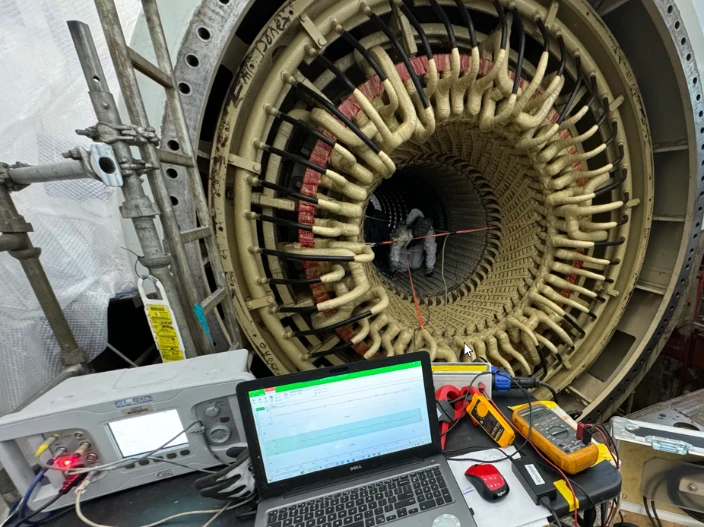
During a planned outage on a 500-megawatt liquid-cooled GE generator, routine DC Leakage and Hi-Pot testing was being performed on the stator winding. Phases A and C tested excellently. However, Phase B exhibited serious insulation breakdown, with leakage current spiking at progressively lower voltages across multiple test attempts. What started as a standard verification quickly turned into a critical troubleshooting and repair effort.
The DC Leakage test was planned to reach a maximum of 40 kV DC. On the first attempt, leakage current spiked unexpectedly at 36 kV. After thorough cleaning of HV bushings and accessible winding areas, the test was repeated — this time the failure occurred at 33 kV. Following 24 hours of forced-air drying (30,000 watts) and additional intensive cleaning, the issue reappeared at only 27 kV. It became clear that the insulation system had sustained damage and was trending rapidly toward failure. The customer needed the exact location identified and repaired during the planned outage window to avoid a potentially catastrophic in-service failure.
A combination of advanced diagnostic tools was deployed to locate the fault:
Both the ultrasonic and infrared cameras clearly pinpointed Top Bar 32 as the source of the problem. Ultrasonic camera view of top bar 32 while at 33 kVDC Infrared camera view of top bar 32 while at 33 kVDC
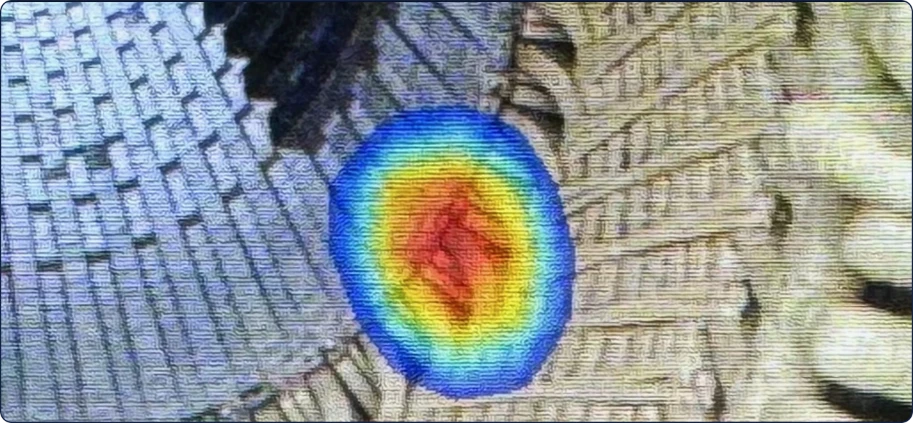
Ultrasonic camera view of top bar 32 while at 33 kVDC
The decision was made to replace the defective bar. Top Bar 32 was electrically isolated from the rest of Phase B. The phase was then re-tested starting with 5 kV Megger and Polarization Index (PI) measurements. Results were excellent, confirming that the remainder of the phase was sound. A full DC Leakage and Hi-Pot test was then successfully completed on the isolated phase up to 44 kV. The defective Top Bar 32 was removed and replaced with a new bar. After reinstallation and re-insulation, the entire Phase B was re-tested. Results and Customer Impact. Post-repair testing showed excellent results across all three phases, fully consistent with each other. The unit passed all final electrical tests and was returned to service on schedule. The customer was extremely satisfied that the precise fault location was identified quickly, the repair was completed during the planned outage, and a major in-service failure — which could have caused severe and costly damage — was prevented.
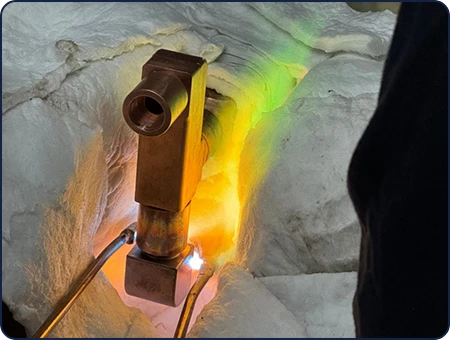
Brazing New series plumbing / electrical connection in place.
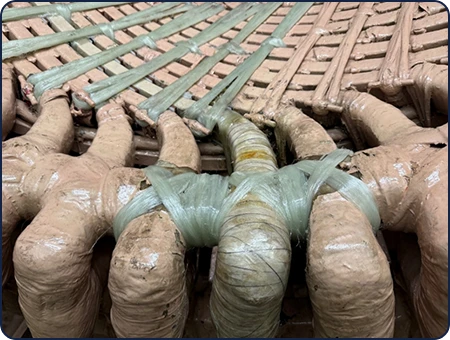
Appearance of stator windings after replacement of the failed top bar (before painting).
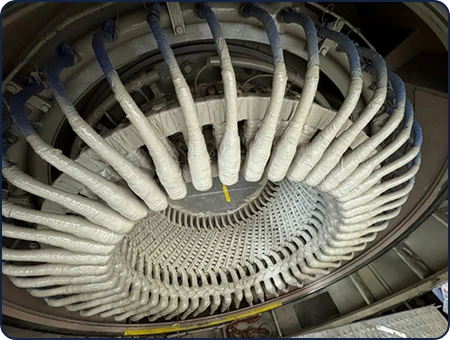
Appearance of the turbine end stator after final painting in as-left condition.
This project highlighted Generex’s core values of SAFETY, and INTEGRITY — working SAFELY with high voltage test equipment and open flame during the brazing process, and INTEGRITY delivering an accurate diagnosis (even if painful for the client to hear at the time) and targeted repair that protected the customer’s asset and schedule.