Collector Brush Maintenance for Generators Explained
Introduction
Collector brushes and brush rigging form the critical sliding electrical interface in generators equipped with traditional (brushed) excitation systems. The brushes carry high DC field current from the stationary excitation system to the rotating rotor slip rings (collector rings), while the rigging assembly maintains precise radial pressure, alignment, and freedom of movement. Proper maintenance of these components is essential to ensure reliable current transfer, prevent arcing and flashovers, minimize wear, and avoid unplanned outages due to loss of excitation or ground faults.
Poor collector and brush maintenance and cleanliness is one of the leading causes of in-service failures, yet it is also one of the easiest types of failures to avoid with proper maintenance and routine inspections.
Background
Brushed excitation systems remain common on many legacy and some modern large utility generators, typically older steam-turbine units or specific hydro machines. Over decades of operation, brushes experience mechanical wear, electrical arcing, contamination from carbon dust, and spring fatigue. OEMs (GE, Westinghouse, Siemens, and others) have long emphasized disciplined brush and rigging maintenance in their Technical Information Letters (TILs) and Operation & Maintenance Manuals (OMMs).
Neglected collector/slip-ring systems are a leading cause of forced outages, excessive carbon dust accumulation (fire and contamination hazard), slip-ring grooving, and vibration issues. Regular maintenance extends brush life from hundreds to thousands of operating hours and protects the overall excitation system.
Theory of Operation
Collector brushes are made of specially formulated carbon, graphite, or metal-graphite composites chosen for low friction, good conductivity, and film-forming properties on the slip rings. The brush rigging applies controlled spring pressure (typically 2–4 psi or manufacturer-specified kPa) to keep the brush face in intimate contact with the polished slip-ring surface while allowing radial wear compensation.
Current transfer occurs through a thin oxide film that forms on the slip-ring surface. Proper pressure, brush grade, and ring surface condition ensure low contact resistance and minimal arcing. Excessive pressure causes rapid wear and overheating; insufficient pressure causes bouncing, arcing, and poor film formation. The system must also maintain circumferential stagger (brushes offset axially and circumferentially) to distribute current evenly and prevent localized heating or grooving of the rings.
Maintenance Procedures
Maintenance is performed during scheduled outages and supplemented by online visual checks.
- Daily/Weekly Online Monitoring
- Use a strobe light to observe brush condition, sparking, and dust buildup while the unit is running.
- Listen for unusual noise or vibration at the brush rigging.
- Check for proper brush position in holders and freedom of movement.
- Outage Inspections and Measurements
- Brush Length: Measure remaining length with a caliper. Replace brushes when they reach the manufacturer’s minimum wear limit (typically ½ to ⅔ of new length).
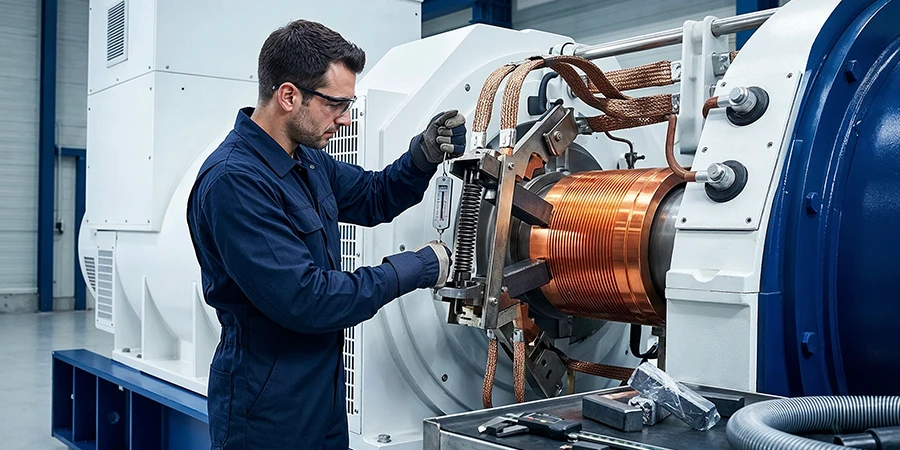
- Spring Pressure: Use a calibrated brush pressure gauge or spring scale. Adjust or replace springs to maintain OEM-specified pressure.
- Brush Holders and Rigging: Inspect for wear, binding, corrosion, or misalignment. Ensure holders are perpendicular to the slip rings and have proper radial clearance (typically 2–3 mm).
- Slip Rings: Check surface condition for uniform oxide film, grooving, threading, eccentricity, or discoloration. Light polishing with approved stones or compounds may be required.
- Shunts and Connections: Verify flexible shunts are intact and securely attached.
- Insulation: Perform insulation resistance (Megger) and polarization index (P.I.) tests on rigging insulators and leads.
- Cleaning
- Vacuum or wipe away carbon dust (never use compressed air, which drives dust deeper).
- Clean brush holders, springs, and rigging with approved solvents.
- Polish slip rings only as needed to restore film; avoid over-polishing.
- Brush Replacement and Bedding
- Replace brushes in sets, staggering replacements to maintain even current distribution.
- Bed new brushes by running at light load with occasional light polishing to form a proper contact surface.
- Maintain correct stagger pattern and polarity orientation.
- Documentation and Trending
- Record brush wear rates, spring pressures, ring conditions, and any anomalies.
- Trend data to predict replacement intervals and detect abnormal wear patterns.
Need Maintenance Direction
and Support?
Place a Generex Technical Field Advisor on-site to oversee work, guide technicians, and protect your interests.
Common Issues and Remedies
Slip rings are frequently helically grooved to promote proper film formation and dust removal. The minimum required groove depth before the rings must be re-grooved or replaced is typically 0.010 to 0.020 inches (0.25–0.5 mm), depending on OEM specifications. When groove depth falls below this threshold or the grooves become worn flat (depth < 0.005 inches), the rings require machining or full replacement to restore proper brush contact and film formation.
- Dishing (concave wear in the center of the ring): Caused by uneven brush pressure or improper stagger. Fix: Machine the ring flat or replace the slip ring.
- Grooving (deep helical or axial grooves): Caused by abrasive contamination or excessive brush pressure. Fix: Re-groove or replace rings when depth falls below the minimum threshold; clean brushes and rigging.
- Brush Skipping (intermittent contact causing arcing): Caused by binding brush holders, low spring pressure, or contaminated/worn rings. Fix: Clean and lubricate holders, adjust or replace springs, and re-bed brushes.
- Oxidation (excessive black or blue oxide film): Caused by poor film formation due to incorrect brush grade or insufficient current density. Fix: Light polishing of rings and replacement with the correct brush grade.
- Pitting (small craters from arcing): Caused by arcing due to poor contact or contamination. Fix: Machine or replace rings and address root cause (pressure, cleanliness, or brush grade).
- Overheating (discoloration, burning, or bluing): Caused by high current density, poor contact, or overloaded brushes. Fix: Check connections and current sharing; replace damaged brushes/rings and correct pressure.
- Rusting (corrosion/oxidation of the slip-ring surface): Caused by prolonged exposure to inclement weather, high humidity, or shutdown periods without environmental control or space heaters. Fix: Thorough cleaning and polishing of rings, application of protective coatings if recommended by OEM, and implementation of proper storage/heater procedures during outages.
Repair Scenarios
- Minor Issues (light sparking, marginal wear): Adjust spring pressure, clean rigging, or polish rings lightly with untreated canvas at low shaft speed. Re-test after correction.
- Moderate Issues (uneven wear, grooving, binding holders): Replace brushes, springs, or individual holders. Re-bed and re-test.
- Severe Issues (heavy arcing, deep grooving, widespread contamination, or insulation failure): Machine or replace slip rings, overhaul or replace the rigging assembly, and perform full rotor diagnostic testing (Megger/P.I., RSO, etc.) after repair.
All repairs require a post-maintenance run-in period and re-verification of brush pressure, alignment, and electrical performance before returning the unit to service.
IEEE & ANSI Documentation
Maintenance of collector brushes and brush rigging is addressed in IEEE Std 56-2016, IEEE Guide for Insulation Maintenance of Electric Machines, and IEEE Std 115-2019, IEEE Guide for Test Procedures for Synchronous Machines. OEM TILs and OMMs provide specific pressure, wear limits, and stagger recommendations. IEEE standards are frequently dual-designated as ANSI/IEEE and represent the globally recognized best practice.
Summary & Conclusions
Proper maintenance of collector brushes and brush rigging is fundamental to the reliable operation of generators equipped with brushed excitation systems. Poor collector and brush maintenance and cleanliness is one of the leading causes of in-service failures, yet it is also one of the easiest types of failures to avoid with proper maintenance and routine inspections. Regular inspections, precise spring pressure control, timely staggered brush replacement, and diligent cleaning of slip rings and rigging prevent arcing, excessive wear, and contamination that can lead to loss of excitation or forced outages. By following OEM guidelines, maintaining accurate records, and trending performance data, utilities achieve thousands of hours of trouble-free service from these critical components. In an era of aging fleets and increasing cyclic duty, disciplined brush and rigging maintenance remains one of the highest-return activities in a generator predictive-maintenance program.

About the Author
Charles J. Wolfe is the Founder and Principal Engineer of Generex Consulting, with over 30 years of global experience in power generation. He is a recognized expert in generator and excitation systems, trusted by clients worldwide for solving complex engineering challenges.