Generator Rotor Inspection, Testing & NDT: A Complete Guide
Background
Large utility turbine-driven generators rely on the rotor (field) winding to produce the rotating magnetic field essential for power generation. These cylindrical rotors, often weighing tens of tons and operating at 3600 or 1800 rpm, endure extreme centrifugal forces, thermal cycling from load changes, and continuous electromagnetic stresses. Over decades of service—typically 30–50 years—the rotor winding insulation experiences degradation from vibration, copper creep, contamination, and mechanical fatigue. Early detection through inspection, nondestructive testing (NDT), and refurbishment prevents ground faults, shorted turns, and thermally sensitive behavior that can cause rotor bowing, increased vibration, and forced outages costing millions. For consulting firms specializing in generator testing, inspection, and repair, rotor winding expertise—including comprehensive NDT—is a high-value service that extends asset life and optimizes outage planning.
Theory of Operation
The rotor winding consists of copper conductors (typically silver-bearing for high-temperature strength) arranged in slots around the forged steel rotor body. Direct or indirect hydrogen cooling removes heat, while the winding is insulated with turn insulation (between individual conductors) and groundwall insulation (slot armor separating the winding from the rotor body). Centrifugal force at speed presses the winding firmly against the slot walls and retaining rings. During operation, DC excitation current flows through the winding, creating the magnetic field. Load cycling causes thermal expansion and contraction of the copper, which has a higher coefficient of thermal expansion than the insulation and steel. This differential movement, combined with 120 Hz electromagnetic forces (on 60 Hz systems), leads to fretting, insulation abrasion, and potential shorted turns. Shorted turns reduce effective ampere-turns, causing uneven heating, rotor thermal sensitivity, and vibration. Proper inspection and NDT of both the winding and the associated mechanical components (rotor body, retaining rings) are required to maintain dielectric integrity under these extreme conditions.
Introduction
Generator rotor winding inspection, testing, and refurbishment are critical elements of a comprehensive predictive maintenance program for large utility turbine-driven generators. With the rotor removed during major outages, teams gain direct access to the winding, slot contents, end turns, retaining ring insulation, collector rings, and rotor body. Visual and mechanical inspections reveal early signs of degradation, while electrical tests quantify insulation condition and detect hidden faults such as shorted turns. A full suite of nondestructive testing (NDT) modalities applied to the rotor forging, retaining rings, and other mechanical components ensures that surface and subsurface defects are identified before they propagate. Timely refurbishment—ranging from minor repairs to full rewinds—can restore reliability and often avoid the need for a new rotor forging, which carries long lead times and high costs. This article outlines practical techniques, all applicable NDT modalities, industry standards, common failure modes, and repair strategies to help plant operators and maintenance teams make informed decisions that maximize generator availability and service life.
Maintenance Procedures
Rotor winding maintenance begins with safe rotor removal and follows a structured process:
- Preparation and Safety — Lockout/tagout, rotor extraction, and placement on suitable stands or pedestals with proper support to avoid distortion.
- Visual Inspection — Examine the full winding surface, slot wedges, creepage blocks, slot armor, end-turn blocking, and retaining ring insulation for abrasion, cracking, migration, or contamination. Pay special attention to high-stress areas near slot exits and under retaining rings.
- Mechanical Checks — Tap-test or measure wedge tightness; inspect for copper distortion, loose blocking, or retaining-ring liner issues. If the unit is hydrogen-cooled, pressure-test the radial stud seals.
- Nondestructive Testing (NDT) Modalities — A complete rotor evaluation requires multiple complementary NDT methods to detect surface, near-surface, and volumetric defects in the rotor body, retaining rings, and associated components:
- Dye Penetrant Testing (PT): Liquid penetrant is applied to non-porous surfaces (especially retaining rings and rotor teeth) to reveal surface-breaking cracks or porosity. Fluorescent dye penetrant combined with UV (ultraviolet) light inspection dramatically improves sensitivity by causing indications to glow brightly under black light in a darkened environment.
- Magnetic Particle Testing (MT/MPI): Used on ferromagnetic rotor body and shaft components; magnetic particles are applied while the part is magnetized (wet fluorescent or dry visible methods). Surface and near-surface discontinuities create visible particle accumulations, often viewed under UV light for fluorescent particles.
- Phased Array Ultrasonic Testing (PAUT): An advanced ultrasonic technique that uses an array of transducers to steer and focus sound beams electronically. It provides rapid, high-resolution volumetric inspection of retaining rings, rotor body, and slot regions for cracks, inclusions, or fatigue damage without the limitations of conventional single-element UT.
- Boresonic Inspection: A specialized ultrasonic examination performed from inside the rotor bore (central axial hole). High-frequency transducers scan for internal defects, inclusions, or forging discontinuities that could propagate outward under centrifugal stress.
- Hardness Testing: Portable Rockwell, Brinell, or Vickers testers measure surface hardness on rotor teeth, retaining-ring seating areas, and shaft journals to detect material softening, embrittlement, or heat-affected zones from previous repairs or overheating.
- Eddy Current Testing (ECT): A non-contact electromagnetic method ideal for detecting surface and near-surface cracks in non-magnetic retaining rings and collector rings; highly sensitive to small discontinuities and can be automated for circumferential scanning.
- Conventional Ultrasonic Testing (UT): Straight-beam or angle-beam UT for thickness measurements and defect sizing in areas not suited to phased array.
- Radiographic Testing (RT): Used selectively (e.g., on welds or complex geometries) when other methods are inconclusive, though limited by access and radiation-safety concerns.
- Acoustic Emission Testing (AET): Can be applied during spin-up or load testing for real-time monitoring of active crack growth.
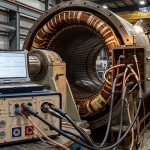
- Electrical Testing — Perform insulation resistance (IR), polarization index (PI), winding resistance, and recurrent surge or impedance testing for shorted turns.
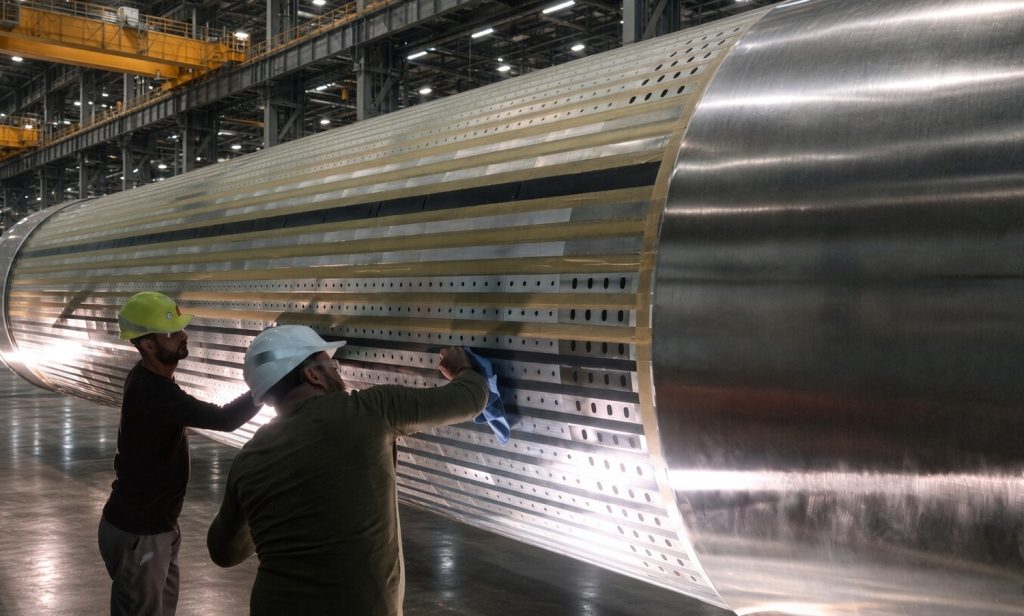
- Cleaning — Use a dry vacuum, or wipe by hand with rags and an OEM-approved electrical solvent; address any oil contamination or foreign material. Do not use compressed air, as it can move contamination from a bad location into a worse one.
- Documentation — Record all findings with photographs, measurements, and location tagging.
These procedures, including the full NDT suite, are typically performed every 4–8 years or after operational anomalies such as high vibration or excitation issues. Robotic or borescope inspections can supplement between full outages.
IEEE and ANSI Guidance
Industry standards provide essential guidance for rotor winding evaluation and maintenance. ANSI/IEEE Std 67 (Guide for Operation and Maintenance of Turbine-Generators) emphasizes combining visual inspection, electrical testing, and nondestructive examination of mechanical components. IEEE Std 43 (Recommended Practice for Testing Insulation Resistance of Electric Machinery) details procedures for IR and PI measurements on rotor windings. Additional relevant documents include IEEE C50.13 (Standard for Cylindrical-Rotor Synchronous Generators) and EPRI reports on generator visual inspection, electrical testing, and NDT of retaining rings and rotor forgings. While specific hipot test levels for rotor windings lack uniform IEEE guidelines in some cases, best practices recommend conservative DC or AC overpotential tests tailored to the insulation class and machine history, always preceded by NDT to avoid masking defects. Adherence to these standards ensures consistent evaluation, supports regulatory compliance (e.g., NERC), and helps demonstrate due diligence for insurance and warranty purposes.
Place a Generex Technical Field Advisor on-site to oversee work, guide technicians, and protect your interests.
Need Maintenance Direction
and Support?
Documentation
Thorough documentation transforms inspection and NDT data into actionable intelligence. Maintain a standardized digital checklist that captures:
- Exact locations of defects (slot number, axial position, pole or quadrant).
- Descriptions and severity ratings of visual and NDT findings, with high-resolution annotated photographs (including UV and fluorescent indications).
- Electrical test results (IR, PI, resistance, shorted-turn indications) with temperature corrections.
- Comparison to previous outage data for trending.
- Quantitative NDT results (e.g., crack sizing from PAUT or boresonic, hardness values).
Store records in a secure, searchable database tied to the generator serial number and outage dates. High-quality documentation satisfies IEEE requirements, facilitates root-cause analysis, and supports long-term life assessment of the rotor.
Common Issues and Remedies
Common rotor winding problems include shorted turns, groundwall insulation degradation, copper creep/distortion, slot component migration, and contamination. NDT modalities are indispensable for detecting related mechanical issues in retaining rings and the rotor body. Shorted turns often result from turn insulation abrasion, copper burrs, or contamination; they cause localized overheating, thermal sensitivity, and rotor bowing. Symptoms include changes in winding resistance or detection via recurrent surge oscillation (RSO) or flux probe testing. Ground insulation (slot armor) can crack or abrade due to repeated thermal cycling and centrifugal forces, leading to ground faults. End-turn blocking and retaining-ring insulation may loosen or crack, allowing copper movement. Oil contamination from seal leaks accelerates degradation. Retaining rings are especially vulnerable to stress-corrosion cracking, which is readily detected by dye penetrant (with UV), magnetic particle, phased array UT, eddy current, or boresonic methods. Hardness testing identifies material degradation that predisposes rings to cracking. Remedies include:
- Cleaning and re-insulating localized areas with compatible materials (e.g., modern Nomex or glass laminates).
- Replacing damaged turn or ground insulation.
- Re-blocking end turns and installing improved slip planes or creepage blocks to accommodate expansion.
- Applying new retaining-ring insulation with Teflon slip layers where appropriate.
- For NDT-detected cracks: grind out and blend, or replace components as required.
Early intervention during minor outages frequently prevents escalation to a full rewind.
Repair Scenarios
Repair scope is determined by inspection, electrical testing, and NDT findings:
- Minor — Localized abrasion, light contamination, or minor blocking issues with no NDT indications: cleaning, re-insulation touch-up, and re-blocking (typically 1–2 weeks in a shop or on-site).
- Moderate — Shorted turns, widespread insulation degradation, slot filler migration, or NDT indications of small surface cracks (detected by dye penetrant, magnetic particle, eddy current, or phased array): partial rewind of affected poles/sections, new turn/ground insulation, upgraded blocking, and crack blending (2–4 weeks).
- Major — Extensive copper distortion, severe groundwall damage, or retaining-ring concerns with significant NDT findings (e.g., deep cracks via boresonic or PAUT) or hardness anomalies: full rotor rewind with new copper (or reuse of the original if condition allows), modern insulation systems, retaining-ring replacement or repair, and comprehensive NDT re-verification (6–12+ weeks).
All repairs must use Class F or higher insulation materials compatible with the original design and include post-repair testing (IR, PI, hipot, shorted-turn verification, and repeat NDT). Retaining rings should undergo full NDT (phased array, dye penetrant/UV, magnetic particle, eddy current, and hardness) as part of major work.
Summary and Conclusions
Generator rotor winding inspection, testing, and refurbishment are essential for maintaining the reliability of large utility turbine-driven generators. Through systematic visual examination, electrical testing, and the complete suite of nondestructive testing modalities—dye penetrant (with UV), magnetic particle, phased array ultrasonic, boresonic, hardness testing, eddy current, conventional ultrasonic, radiographic, and acoustic emission—operators can detect issues such as shorted turns, insulation degradation, component migration, and critical mechanical defects in retaining rings and the rotor body before they cause thermal sensitivity, vibration, or catastrophic faults. Proper documentation and timely repairs—from localized fixes to full rewinds—extend rotor life, reduce outage durations, and avoid the high cost and lead time of rotor replacement. For utilities facing aging fleets and increasing cyclic duty, investing in expert rotor winding programs that incorporate all applicable NDT techniques delivers significant returns in availability, safety, and long-term performance. Implementing the techniques described here positions maintenance teams to proactively manage one of the most critical and highly stressed components in the generator.

About the Author
Charles J. Wolfe is the Founder and Principal Engineer of Generex Consulting, with over 30 years of global experience in power generation. He is a recognized expert in generator and excitation systems, trusted by clients worldwide for solving complex engineering challenges.