Generator Rotor Life Assessment Inspection & Extension Methods
INTRODUCTION
Generator rotor life assessment, inspection, and extension methods are essential for managing the long-term reliability of large utility turbine-driven synchronous generators. Rotors, often designed for 30–40 years of service, face cumulative damage from thermal cycling, centrifugal stresses, fatigue, and creep under modern operating regimes that include increased cyclic duty and load following. Accurate life assessment allows utilities to make informed decisions on continued operation, targeted repairs, or replacement while avoiding unplanned outages or catastrophic failures. For consulting firms specializing in generator testing, inspection, and repair, these services provide critical support by combining advanced nondestructive testing (NDT), engineering analysis, and practical refurbishment strategies to safely extend rotor life and optimize outage planning.
BACKGROUND
Large cylindrical-rotor generators operate at high speeds with massive forgings that experience repeated start-stop cycles, load changes, and electromagnetic forces. Over time, damage accumulates in the rotor body, bore, retaining rings, slot walls, and end regions. Historically, rotors were retired based on conservative OEM design life or calendar age. Today, utilities extend service through data-driven life assessments that incorporate actual operating history, inspection results, and fracture mechanics. Key concerns include forging discontinuities, fatigue cracking at stress concentrations (e.g., keyways, fillets), and degradation of retaining rings due to stress corrosion cracking. EPRI and industry programs emphasize risk-based approaches that balance safety with economic life extension, often allowing safe operation well beyond original design expectations when supported by robust inspections and analysis.
OPERATIONAL PRINCIPLES
Rotor life is governed by the interaction of mechanical stresses, material properties, and operating conditions. Centrifugal forces create high hoop and radial stresses, while thermal transients during startup, shutdown, and load changes induce low-cycle fatigue. High-cycle fatigue arises from vibration and electromagnetic forces at twice line frequency (120 Hz). Creep becomes relevant at elevated temperatures in heavily loaded rotors. Life assessment integrates:
- Boresonic inspection — Ultrasonic examination from the rotor bore to detect internal forging defects, inclusions, or cracks.
- Fracture mechanics — Calculates crack growth rates and critical flaw size using actual flaw data, material toughness, and stress profiles.
- Cumulative damage models — Account for fatigue (S-N or strain-life curves) and creep using operating hours and cycle counts.
- Finite element analysis (FEA) — Models stress distributions under various operating scenarios.
Remaining life is estimated as the time or cycles until a flaw reaches critical size or cumulative usage reaches an acceptable limit (often with safety factors). Modern tools, such as EPRI’s SAFER code or similar fracture mechanics software, refine predictions by incorporating site-specific data.
PROCEDURES
Rotor life assessment begins with comprehensive inspections during major outages when the rotor is removed:
- Preparation — Safe rotor extraction, cleaning, and placement on supports to prevent distortion.
- Visual and Dimensional Inspection — Examine the rotor body, slots, journals, coupling, and retaining rings for surface damage, fretting, or distortion. Measure runout and clearances.
- Nondestructive Testing — Perform boresonic ultrasonic testing of the bore and body; phased-array UT or eddy current on slot walls and retaining rings; dye penetrant or magnetic particle on accessible surfaces; hardness testing for material degradation.
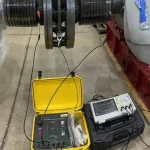
- Electrical and Mechanical Testing — Recurrent Surge Oscillography (RSO) or impedance testing for shorted turns; vibration and balancing data review.
- Data Integration and Analysis — Compile operating history (hours, starts, load profiles), inspection results, and material data into a life assessment model. Perform fracture mechanics evaluation to estimate remaining life and recommend inspection intervals.
- Documentation — Create detailed reports with flaw maps, NDT results, analysis outputs, and risk rankings.
These procedures are typically performed every 8–12 years or after significant events, with interval extensions justified by engineering analysis.
Get independent technical advisory for your power generation project, from design review to project oversight.
Need Expert
Engineering Guidance?
REPAIR SCENARIOS
Repair and extension strategies are tailored to assessment findings:
- Minor — Surface blending of small defects, localized re-insulation, or minor balancing: performed during routine outages with minimal life impact.
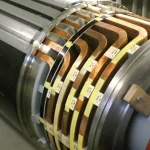
- Moderate — Retaining ring replacement (e.g., 18-5 to 18-18 upgrade), slot filler repairs, or partial winding refurbishment: extends life by addressing high-risk areas (2–6 weeks).
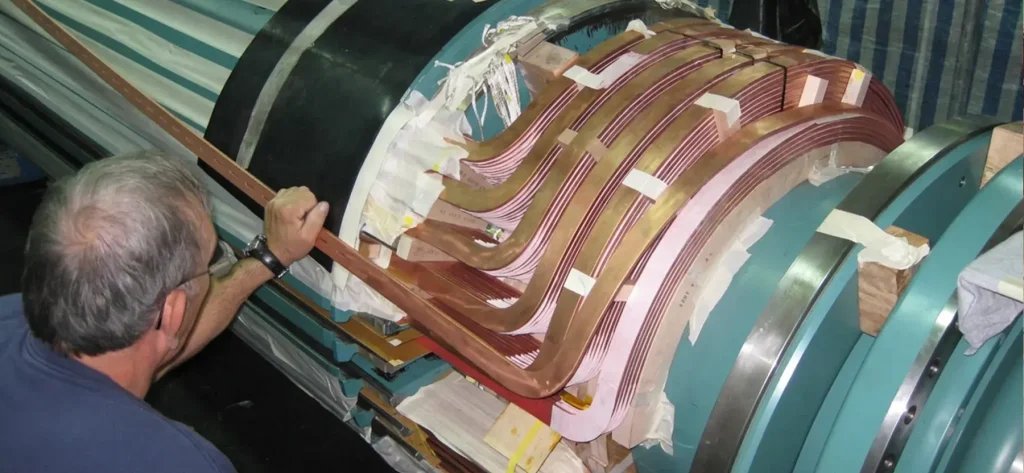
- Major — Full rotor rewind with modern insulation, journal repair or sleeving, high-speed balancing, and comprehensive NDT verification: significantly resets fatigue life (6–12+ weeks). In some cases, rotor replacement is selected when multiple damage mechanisms converge or forging integrity is compromised.
Post-repair assessments confirm improved condition and may support extended inspection intervals.
COMMON ISSUES AND REMEDIES
Common rotor life-limiting issues include:
- Forging discontinuities or inclusions detected by boresonic inspection — Remedy: fracture mechanics analysis to determine acceptable flaw size and safe operating interval; monitor for growth.
- Fatigue cracking at stress risers (keyways, fillets, slot bottoms) — Remedy: blend/grind cracks, install stress-relief features, or perform full rotor refurbishment.
- Retaining ring degradation (especially SCC in older 18-5 material) — Remedy: upgrade to 18-18 rings and improve moisture control via seal oil systems.
- Shorted rotor turns causing thermal sensitivity and bowing — Remedy: RSO testing for detection followed by localized or full winding repair.
- Creep or material softening in high-temperature regions — Remedy: hardness testing and metallurgical sampling to validate continued service or schedule replacement.
Remedies emphasize early detection through combined NDT, accurate life modeling, and targeted interventions that address root causes rather than symptoms.
IEEE & ANSI DOCUMENTATION
IEEE Std 67 (Guide for Operation and Maintenance of Turbine-Generators) offers practical recommendations for rotor inspection, testing, and maintenance, including life assessment considerations. IEEE C50.13 (Standard for Cylindrical-Rotor Synchronous Generators) defines design and performance requirements that form the basis for life evaluations. Supporting EPRI reports provide detailed methodologies for boresonic inspection, remaining life estimation using fracture mechanics, and rotor life extension strategies. Thorough documentation of inspection data, operating history, analytical results, and repair records is critical for NERC compliance, regulatory audits, insurance purposes, and demonstrating due diligence in asset management.
SUMMARY & CONCLUSIONS
Generator rotor life assessment, inspection, and extension methods enable utilities to safely maximize the service life of large turbine-driven generators beyond original design expectations. By integrating advanced NDT (particularly boresonic and phased-array ultrasonic), detailed operating history review, and fracture mechanics analysis, operators can quantify remaining life, identify high-risk areas, and implement targeted repairs.
Common damage mechanisms—fatigue, forging defects, shorted turns, and retaining ring issues—can be effectively managed through proactive programs that combine inspection with refurbishment options such as winding repairs, ring upgrades, and high-speed balancing. Adherence to IEEE Std 67, IEEE C50.13, and EPRI best practices, supported by rigorous documentation and risk-based decision making, ensures safety, reliability, and regulatory compliance. For utilities facing aging fleets and evolving operational demands, expert consulting in rotor testing, inspection, and life extension delivers substantial value by reducing replacement costs, minimizing outage durations, and enhancing overall generator availability. Implementing these methods represents a proven, data-driven approach to long-term asset optimization in today’s power generation landscape.

About the Author
Charles J. Wolfe is the Founder and Principal Engineer of Generex Consulting, with over 30 years of global experience in power generation. He is a recognized expert in generator and excitation systems, trusted by clients worldwide for solving complex engineering challenges.