HIT Skid Testing & Dryout of Water-Cooled Generator Stators
Introduction
Large utility generators with direct water-cooled stator windings use hollow copper conductors through which demineralized water circulates to remove I²R, eddy-current, and ohmic heat. Over time, or after major maintenance, these systems can accumulate moisture or develop leaks at brazed joints, strand connections, or insulation interfaces. Water in the insulation causes electrical tracking, reduced dielectric strength, and potential ground faults, while leaks can allow hydrogen ingress (in hydrogen-cooled machines) or coolant contamination.
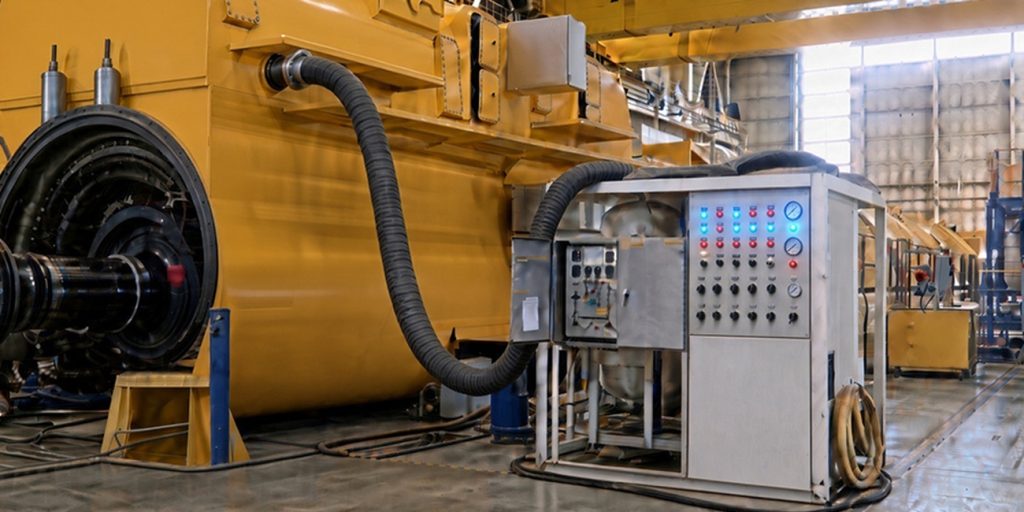
The HIT Skid (Hydraulic Integrity Test Skid) is a portable, self-contained test system that performs a complete dryout and leak-detection sequence on the stator cooling water system. It combines blowdown, vacuum drying, pressure decay, vacuum decay, and helium tracer gas testing to ensure the stator bars are completely dry and leak-free before returning the generator to service.
Background
Direct water-cooled stator windings were introduced in the 1950s–1960s for large turbo-generators (typically >200 MW) to achieve higher power densities. Early field experience showed that even small leaks or residual moisture could lead to insulation failures within months. Traditional drying methods (hot-air blowers or natural evaporation) were slow and unreliable.
Stator hydraulic integrity test systems (such as the HIT Skid or WESkid) were developed by OEMs and specialized service providers as a standardized, efficient field tool. They are now used worldwide during commissioning, major outages, rewinds, and post-repair verification, as well as within the standard test and inspection scope at maintenance outages.
The full sequence—blowdown → vacuum drying → vacuum decay → pressure decay → capacitance mapping → helium tracer gas—ensures both moisture removal and quantitative leak detection far more reliably than visual or simple pressure checks.
Theory of Operation
The HIT Skid treats the entire stator cooling-water circuit (hollow conductors, manifolds, and hoses) as a sealed pressure/vacuum vessel. Moisture is removed by repeated pressurization and evacuation via a remote-controlled automated dump valve; leaks are quantified by measuring how quickly pressure changes under controlled conditions.
Blowdown and Vacuum Drying
High-pressure dry air is blown through the system to expel bulk water (the first blowdown). The system is then evacuated to a low absolute pressure (typically <50 microns / milliTorr) using a vacuum pump. Water trapped in insulation or micro-crevices evaporates rapidly because its vapor pressure exceeds the chamber pressure.
Pressure Decay Test
The system is pressurized with dry air to a known gauge pressure specified by the OEM. After stabilization, the supply is isolated and the rate of pressure drop (ΔP/Δt) is measured. A volumetric leak rate can be calculated using the ideal gas law, with appropriate temperature compensation and corrections applied by modern test equipment.
Vacuum Decay Test
The system is evacuated to a deep vacuum state. After isolation, any rise in absolute pressure (ΔP/Δt) indicates air in-leakage. The leak rate formula is analogous:
Q = (V · ΔP / Δt) × K
where K is a conversion factor accounting for the vacuum reference (often expressed in mbar·L/s or atm·cc/s). Vacuum decay is more sensitive than pressure decay for detecting very small leaks because the driving pressure differential is larger.
Helium Tracer Gas Investigation
For precise leak location and quantification when decay tests fail, the system is pressurized with helium (or a helium–air mixture). A mass-spectrometer leak detector (tuned to helium atomic mass 4) is connected in vacuum mode or sniffing mode. Helium molecules escaping through leaks are detected with sensitivity down to 10⁻⁹ atm·cc/s.
The leak rate is read directly from the instrument after calibration with a known leak standard. This step pinpoints individual bar or joint leaks that decay tests cannot locate.
Test Procedure Overview
HIT Skid testing is performed offline, with the rotor removed or in place (if clearance allows). The sequence is:
- Preparation: Drain all stator cooling water. Isolate the winding circuits (phases or groups). Connect the HIT Skid to the supply and return manifolds using quick-connect hoses.
- Initial Blowdown: Pressurize with dry compressed air at an OEM-approved pressure and blow through each circuit until no water exits.
- Vacuum Drying: Evacuate to an accepted vacuum level (usually <1 Torr) while monitoring dew-point or insulation resistance (IR). Maintain vacuum for 24–72 hours (or until IR stabilizes and dew-point reaches an acceptably low level). A tight, substantially leak-free winding system will pull down to a vacuum level of 50 microns or even lower by industry-accepted criteria. Perform an intermediate blowdown if condensate appears.
- Vacuum Decay Test: Evacuate and isolate, then record the absolute pressure rise over time. This is a one-hour test, so it is best performed before the pressure decay test in order to obtain solid information about the unit as early as possible.
- Pressure Decay Test: Pressurize to the target value, isolate, and record pressure versus time for 24 hours. Temperature must be monitored hourly via RTDs or thermocouples, because changes in temperature (T) within the ideal gas law (PV = nRT) can change the computed leak rate.
- Helium Tracer Gas Test (if decay tests fail limits): Pressurize the stator winding volume with pure helium or a helium mixture, then scan with a sniffer probe, or place it in vacuum-chamber mode while monitoring helium concentration.
- Documentation: Record all pressures, atmospheric pressure, stator winding temperatures, times, and leak rates.
The complete process typically takes several days, depending on stator size and initial moisture level. Double-pass stators tend to require additional time due to the doubled path length of the circuits being cleared of water and vapor.
Need Maintenance Direction
and Support?
Place a Generex Technical Field Advisor on-site to oversee work, guide technicians, and protect your interests.
Interpreting Results
Drying success is indicated by high insulation resistance (typically >100 MΩ corrected to 40 °C) and low dew-point readings (typically below −40 °C). Leak-tightness is evaluated through pressure decay testing, vacuum decay testing, and—when indicated—helium tracer gas testing. Acceptable leak rates are defined by the OEM for the specific machine; rapid pressure drops or rising vacuum/helium indications signal leaks that require attention. Trending against factory baseline and prior outage data is essential, as increasing leak rates point to progressive joint or strand degradation.
Actions for Marginal or Poor Results
- Thoroughly clean and re-dry the circuits, then retest.
- Perform visual and borescope inspections as needed.
- Repair options range from localized brazing or re-taping to individual strand/coil replacement or a full rewind, depending on severity. All repairs must be followed by a complete repeat of the HIT Skid sequence to verify integrity.
Repair Scenarios
- Minor leaks: Brazing repair on exposed joints or replacement of individual strands/hoses. Re-test the affected circuit only.
- Moderate leaks (multiple small leaks or insulation interface issues): Localized epoxy injection, re-taping, or strand re-brazing. A full re-dry and re-test is required.
- Severe leaks (high decay rates or widespread helium indications): Bar/coil replacement or a full stator rewind. In extreme cases, core removal may be needed if water has contaminated the insulation.
All repairs are followed by a complete repeat of the HIT Skid sequence to verify integrity before returning to service.
IEEE and ANSI Documentation
While no single IEEE standard is dedicated exclusively to the HIT Skid, the procedures are embedded in broader generator maintenance practices. The primary references are IEEE Std 56-2016 (IEEE Guide for Insulation Maintenance of Electric Machines), which discusses drying and leak-testing of water-cooled windings, and IEEE Std 43-2013 (IEEE Recommended Practice for Testing Insulation Resistance of Electric Machinery), which provides acceptance criteria for insulation resistance after drying. Supporting guidance appears in OEM technical information letters and EPRI reports on stator cooling-water system maintenance.
The test methods also align with the general leak-testing principles in ASME and ISO standards for pressure vessels. Always consult the specific generator OEM’s technical manual for exact acceptance limits.
Summary and Conclusions
The HIT Skid dryout and testing process—blowdown, vacuum drying, pressure decay, vacuum decay, and helium tracer gas testing—provides a rigorous, quantitative method to ensure the hydraulic and dielectric integrity of water-cooled stator windings. By combining physical moisture removal with sensitive leak-rate computation based on pressure/vacuum decay and tracer-gas detection, the HIT Skid prevents moisture-related insulation failures and hydrogen-coolant contamination that could lead to catastrophic outages.
When performed and interpreted according to IEEE 56 and OEM specifications, the process enables utilities to return generators to service with confidence. As fleets age and water-cooled designs remain prevalent in high-output machines, routine HIT Skid testing has become an indispensable part of predictive maintenance, extending stator life and maximizing availability in today’s demanding power market.

About the Author
Charles J. Wolfe is the Founder and Principal Engineer of Generex Consulting, with over 30 years of global experience in power generation. He is a recognized expert in generator and excitation systems, trusted by clients worldwide for solving complex engineering challenges.