Megger & Polarization Index (P.I.) Testing Explained
Introduction
Imagine the insulation around the giant copper coils (windings) inside a power plant generator is like a long, unpressurized garden hose that is closed (capped) at the far end. The Megger is like turning on the faucet and suddenly pushing 5,000 volts of pressure (instead of water) into that hose.
The Garden Hose Analogy — What Happens When You Turn On the Faucet
- The instant you open the faucet, releasing water at 60 PSI into the hose, water rushes in rapidly at first. It fills the empty hose and stretches the flexible hose walls until the pressure inside the hose equals the 60 PSI coming from the faucet.
- Once the pressure equalizes, the fast “inrush” or charging flow stops completely. No more water is needed to fill or stretch the hose.
- After that point, any additional water that continues to flow into the hose can only be caused by leakage — tiny imperfections, cracks, holes, or weak spots in the hose wall letting water seep out.
This is exactly what happens during a Megger test, except we’re dealing with electricity instead of water. Here is a summary of the analogies:
- Voltage = water pressure (5,000 volts instead of 60 PSI)
- Current = water flow (gallons per minute vs. micro-amperes)
- Insulation = the garden hose wall
- Electric Polarization = stretching of the rubber hose wall
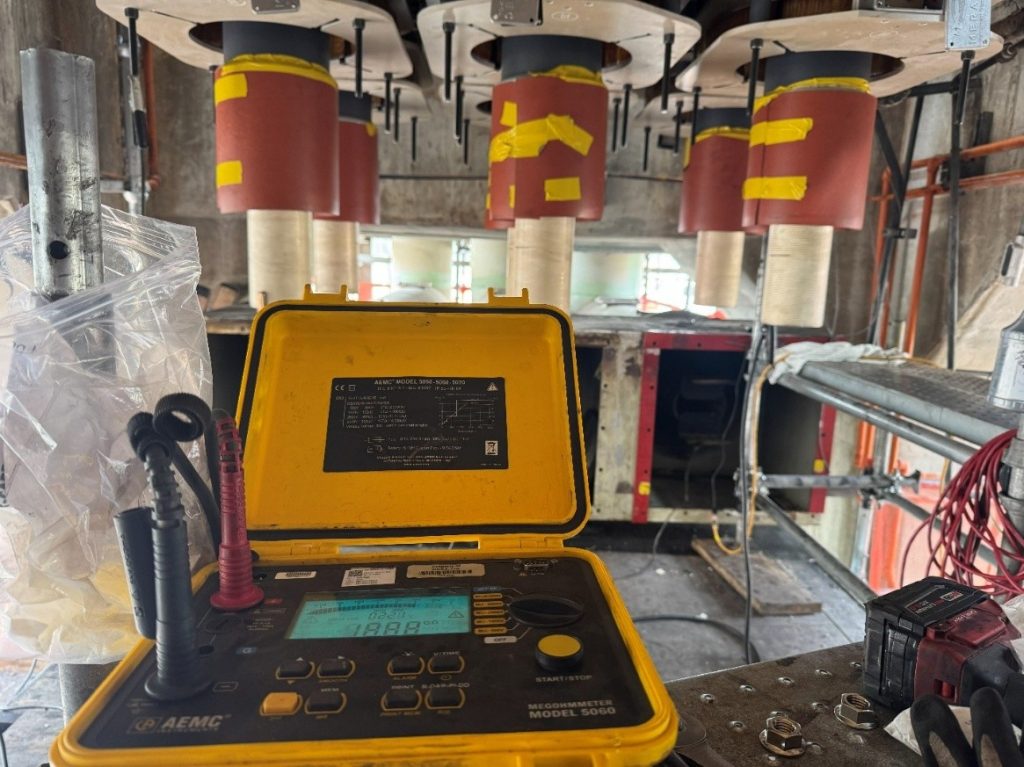
When the Megger first applies 5,000 V DC, there is a big initial inrush of charging current as the insulation “charges up” (like the hose filling and stretching). This charging current drops off quickly in an exponential RC-charging profile once the insulation reaches full voltage. Any current that keeps flowing after the first minute or so is leakage current sneaking through imperfections in the insulation — moisture, dirt, cracks, or aging material.
What Is Polarization Index (P.I.)?
The P.I. test simply watches how the “flow” (current) behaves over time by measuring the insulation resistance (how well the “hose” is blocking leakage) at two points:
- After 1 minute
- After 10 minutes
P.I. = 10-minute resistance reading ÷ 1-minute resistance reading. It’s just a ratio (e.g., 3.2 or 1.4). This ratio tells you whether the insulation is behaving like a good, dry, stretchy hose (resistance keeps climbing nicely) or like a leaky, damaged hose (resistance barely improves because leakage is dominating).
Why the Charging Current Drops Off (Theory)
In the hose:
- Initial rush = filling the empty space + stretching the walls.
- Once pressure equalizes → charging stops.
In the generator insulation:
- Initial high current = geometric capacitance charging (filling the “empty space” in the insulation) + absorption/polarization (the insulation molecules slowly lining up under the electric field, like the hose walls stretching).
- After a minute or two, this charging current dies away.
- What remains is steady leakage current through contamination or damage.
A healthy insulation system shows a big drop in current (and therefore a big rise in resistance) between 1 and 10 minutes → high P.I. A contaminated or wet system has steady leakage from the start → resistance doesn’t rise much → low P.I.
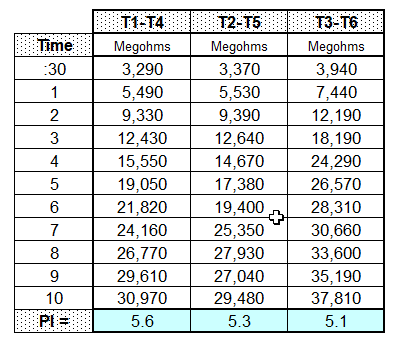
Below is an example of Megger & P.I. data from a “healthy,” robust, and clean insulation system:
Performing the Test
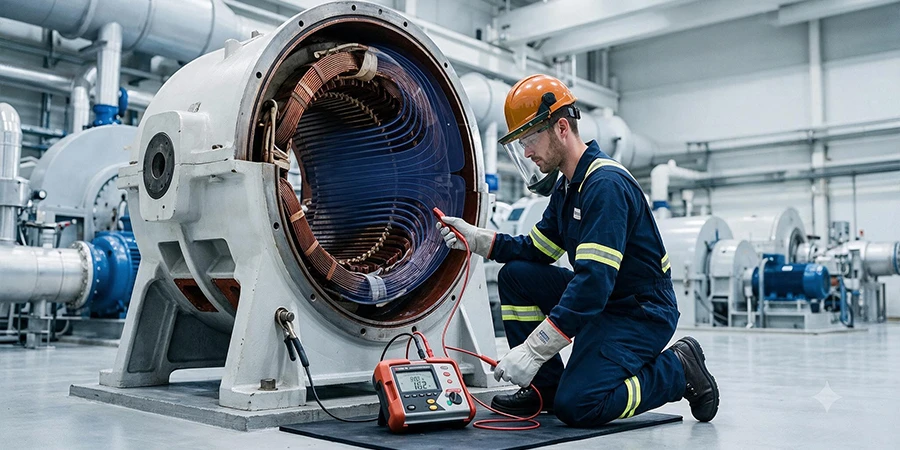
Technicians perform this test only when the generator is shut down and safely isolated during a planned outage.
- Disconnect the windings and ground the other two phases.
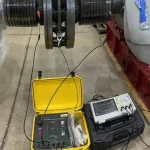
- Connect the Megger: one lead to the winding, the other to the generator frame (ground).
- Apply a steady 5,000 volts DC. If the unit has a nameplate voltage of 6,900 V or less, a lower voltage may be appropriate — be sure to follow your company’s procedures!
- Let it run for a full 10 minutes.
- Record the insulation resistance value every minute, up to the 10-minute mark.
- Repeat for each phase (A, B, and C).
Interpreting Results
Test results should be evaluated against established limits, manufacturer specifications, and historical baseline values to determine the condition and performance of the equipment.
How to Interpret the Results (Good vs. Bad)
You look at both the absolute resistance value and the P.I. ratio. Trending the results over the years is the most useful approach.
| Condition | 1-Minute Resistance (at 40°C) | P.I. Ratio | What It Really Means (Hose Analogy) | Recommended Action |
| Excellent | Very high (thousands of MΩ) | > 4.0 | Perfect dry hose — almost no leakage | None — continue normal operation |
| Good | Well above minimum | 2.0 – 4.0 | Healthy hose with normal minor stretching | Routine maintenance |
| Marginal | Approaching minimum | 1.5 – 2.0 | Some leakage starting — hose has small weak spots | Investigate, clean/dry, retest soon |
| Poor / Problem | Below minimum | < 1.5 (especially < 1.0) | Constant leakage — hose is perforated or soaked | Immediate action needed |
Rough minimum rule (from IEEE standards): for a 13.8 kV generator, aim for at least 1,500 MΩ at one minute. If the 1-minute reading is already extremely high (> 5,000 MΩ), the P.I. becomes less meaningful — just focus on the absolute value and how it’s trending.
What to Do About the Results (Mitigation)
Good results
- The insulation is healthy. Keep good records and retest every 1–3 years (or per your plant’s schedule).
Bad results (low resistance or low P.I.)
Most problems are fixable surface issues, not total failure:
- Dry it out — use space heaters, blow warm dry air through the machine, or heat the whole stator for 24–48 hours or more, then retest.
- Clean it — remove dirt, oil, or contamination using approved methods (dry ice blasting or special solvents), then dry thoroughly and retest.
- If it still fails → call in specialists for more advanced tests (partial discharge, tan-delta, etc.) or consider a rewind.
Need Expert
Engineering Guidance?
Get independent technical advisory for your power generation project, from design review to project oversight.
Controlling Standards and Documentation
Here’s a summary of the main standards that control 5,000 Volt Megger (insulation resistance) tests and Polarization Index (P.I.) results on large utility generators.
Primary Standard: IEEE Std 43
- Full title: IEEE Recommended Practice for Testing Insulation Resistance of Electric Machinery (latest widely referenced version is IEEE 43-2013, which superseded IEEE 43-2000).
- This is the core standard everyone in the industry uses for Megger testing on rotating machinery (including large synchronous generators in power plants).
- It specifically covers:
- How to perform the insulation resistance (IR) test with DC voltage (including recommended test voltages like 5 kV for high-voltage generators).
- The theory behind charging current, absorption/polarization current, and leakage current (exactly matching the garden hose analogy).
- The Polarization Index (P.I.) test procedure: 10-minute reading divided by 1-minute reading.
- Factors that affect results (temperature, humidity, contamination, etc.).
- How to interpret results (good vs. bad P.I. values, minimum acceptable insulation resistance).
- Limitations (e.g., when insulation resistance is extremely high — above 5,000 MΩ — the P.I. may become less meaningful).
- Temperature correction to 40°C (104°F).
Key Guidance from IEEE 43 on Interpretation
- Minimum P.I. is generally ≥ 2.0 for most modern insulation systems (Class B, F, H). Values > 4.0 are often considered excellent.
- A P.I. < 1.5 (especially < 1.0) is a strong warning sign of moisture, dirt, or degradation.
- Minimum 1-minute insulation resistance is often expressed as roughly (rated kV + 1) × 100 MΩ or similar formulas, corrected to 40°C. For a typical 13.8 kV generator, you’re looking for well over 1,000–1,500 MΩ as a baseline.
Supporting / Complementary Standards
- ANSI/NETA MTS (Maintenance Testing Specifications) and ANSI/NETA ATS (Acceptance Testing Specifications) — these are widely used by testing companies and utilities. They often reference IEEE 43 directly for the test method and minimum values on rotating machinery, while providing their own tables for minimum acceptable Megger readings.
- IEEE Std 95 — Recommended Practice for Insulation Testing of AC Electric Machinery with High Direct Voltage (covers higher-voltage DC testing and overvoltage/hipot tests that often follow a Megger + P.I. test).
- IEEE Std 115 or other machine-specific standards — sometimes referenced for overall generator testing procedures.
Summary and Conclusions
The 5 kV Megger + P.I. test is a safe, non-destructive way to check if your generator’s insulation is acting like a tight garden hose or a leaky one. By watching how the “flow” behaves over 10 minutes, you catch moisture, dirt, or aging problems early — long before they cause a costly failure or outage. A high insulation resistance value and excellent P.I. give the tester a “green light” to proceed with higher voltage testing such as DC Leakage and Hipot.

About the Author
Charles J. Wolfe is the Founder and Principal Engineer of Generex Consulting, with over 30 years of global experience in power generation. He is a recognized expert in generator and excitation systems, trusted by clients worldwide for solving complex engineering challenges.