Generator Retaining Ring Inspection & SCC Prevention Guide
Introduction
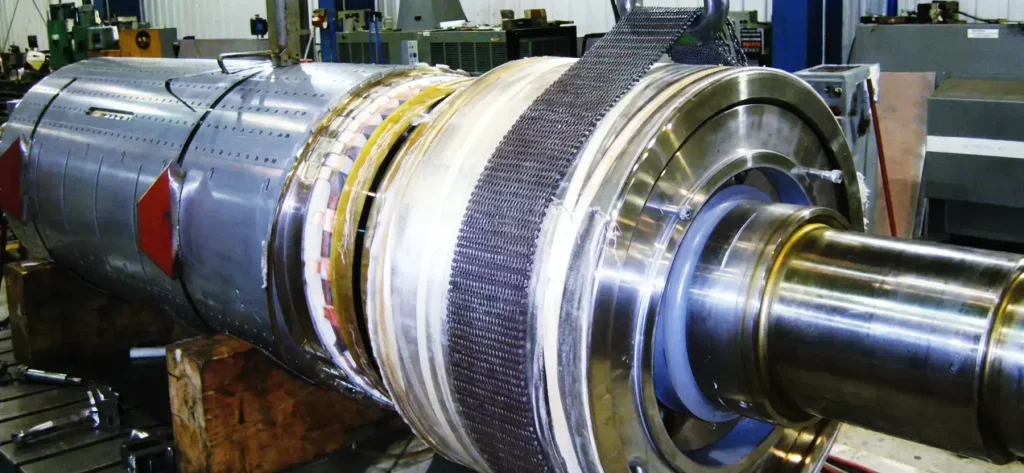
Retaining rings, also called end bells, are among the most highly stressed components in large utility turbine-driven generators. These massive cylindrical forgings secure the rotor end windings against centrifugal forces at operating speeds of 3600 or 1800 rpm. A single failure can eject high-energy fragments, causing catastrophic rotor damage, stator impact, or personnel hazards.
Stress corrosion cracking (SCC) has historically been a leading failure mechanism, particularly in certain ring materials exposed to moisture or contaminants. A thorough retaining ring inspection program, combined with proactive SCC prevention, is essential to identify early degradation, support risk-informed decisions, and enable timely refurbishment or replacement to maintain generator reliability and safety.
Background: Retaining Ring Materials
Retaining rings must withstand tremendous hoop stresses, often exceeding 100 ksi, while operating in a hydrogen or air environment that can introduce moisture, contaminants, or chemical agents. Early designs (pre-1940s) used magnetic steel alloys, but these caused higher eddy-current losses and heating. Non-magnetic austenitic stainless steels were introduced for efficiency. The main material families you will encounter are covered below.
Magnetic Retaining Rings
Typically carbon or low-alloy steels used in older or smaller machines. They are ferromagnetic, which leads to higher losses but generally lower SCC susceptibility in mild environments.
18-5 Non-Magnetic Rings (18Mn-5Cr)
The industry standard from the 1940s through the 1970s. Cold-expanded and work-hardened austenitic steel providing high yield strength (130–175 ksi). Highly susceptible to SCC in the presence of moisture, even at low levels, and the material most associated with historical retaining ring failures.
18-18 Non-Magnetic Rings (18Mn-18Cr)
Introduced in the mid-1970s as a direct replacement for 18-5. Offers significantly improved resistance to SCC while maintaining the required strength and non-magnetic properties. Now the preferred material for both new units and 18-5 upgrade programs.
Other Ring Materials
Early variants such as 8Ni-8Mn-4Cr or 18Mn-4Cr, along with developmental high-strength alloys (for example, modified A286 precipitation-hardened steels or proprietary formulations such as W-RETAINS). Modern rings may incorporate nitrogen additions or specialized heat treatments for enhanced toughness.
SCC in susceptible rings, especially 18-5, has caused numerous industry incidents, prompting widespread replacement programs with 18-18 material and strict moisture-control measures.
Theory of Operation and the SCC Mechanism
Retaining rings encircle and compress the rotor end windings to counteract centrifugal forces that can exceed 10,000 g at the outer radius. They are typically shrink-fitted or keyed onto the rotor body and must maintain dimensional stability under cyclic thermal and mechanical loading.
Material properties are critical: high yield strength prevents plastic deformation, while non-magnetic behavior in 18-5 and 18-18 rings minimizes eddy-current heating. However, the cold-working process used to achieve strength in 18-5 rings leaves residual tensile stresses at the surface, creating ideal conditions for SCC when combined with a corrosive environment (moisture plus chlorides, sulfides, or caustic agents).
Crack initiation occurs inter-granularly at highly stressed locations such as the inner bore, keyways, or shrink-fit surfaces. Once initiated, cracks propagate under sustained hoop stress until critical size is reached, risking ring burst. 18-18 material, with higher chromium content, forms a more stable passive layer, greatly reducing SCC susceptibility even in humid conditions.
Maintenance and Inspection Procedures
Retaining ring maintenance requires a multimodal, risk-informed approach performed with the rotor removed during major outages. The five steps below cover the core scope from visual inspection through documentation and trending.
- Visual and dimensional inspection: Examine inner and outer surfaces, keyways, and shrink-fit areas for discoloration, pitting, or cracks. Measure bore diameter and ovality against baseline.
- Nondestructive testing (NDT): Use fluorescent dye penetrant (with UV light) for surface-breaking cracks, eddy-current testing for subsurface defects, and ultrasonic testing (conventional or phased-array) for volumetric examination. Magnetic particle testing is used only on magnetic rings.
- Material-specific protocols: For 18-5 rings, emphasize moisture history and perform more frequent or comprehensive NDT. For 18-18 rings, inspections can be less stringent but are still required for mechanical integrity.
- Environmental assessment: Review hydrogen dew point trends, seal oil moisture content, and layup practices to evaluate SCC risk.
- Documentation and trending: Record findings with photographs, crack maps, and NDT data, and compare them to previous outages.
Inspections are recommended every 4 to 8 years (more frequently for 18-5 rings), or after significant high-vibration events, per OEM and EPRI guidance. Retaining ring inspection is typically bundled with other mechanical outage scope such as Westinghouse stator bolt checks to make full use of the rotor-out window.
Need Maintenance Direction
and Support?
Place a Generex Technical Field Advisor on-site to oversee work, guide technicians, and protect your interests.
Repair Scenarios Based on Findings
Repair decisions are driven by crack depth, location, and material type. The three scenarios below cover the typical range of intervention, from an in-place cleanup to a full ring replacement with material upgrade.
Minor Findings
Surface pitting or shallow cracks in non-critical areas. Blend or grind out the defects and apply protective coatings. Typical downtime: 1–2 weeks.
Moderate Findings
Deeper cracks or widespread surface degradation. Options include localized weld repair (if permitted by the OEM) or partial ring refurbishment. Typical downtime: 2–4 weeks.
Major Findings
Significant SCC in 18-5 rings or mechanical damage. The remedy is a full ring replacement with 18-18 material, including rotor rebalancing and end-winding re-blocking. Typical downtime: 6–12+ weeks. Replacement is often the preferred long-term solution for high-risk 18-5 rings, since it eliminates ongoing SCC concerns rather than deferring them.
All repairs require post-work NDT, dimensional verification, and high-speed balancing before the rotor is returned to service. Material upgrades from 18-5 to 18-18 eliminate the ongoing SCC concern at the source, and are increasingly the default answer for aging fleets.
Common Issues and Remedies
The primary failure mode is stress corrosion cracking, most prevalent in 18-5 rings exposed to moisture or contaminants. Magnetic rings may experience fatigue or corrosion but rarely SCC. 18-18 rings show excellent resistance, with only rare reports of other mechanical damage. Beyond SCC itself, several other issues show up on retaining rings during outages.
Additional Failure Modes
- Fretting or galling at shrink-fit interfaces.
- Fatigue cracking from cyclic loading or vibration.
- Hydrogen embrittlement in susceptible materials.
Preventive Remedies
- Strict moisture control (maintain hydrogen dew point ≤ 0 °C and seal oil water content < 50 ppm).
- Improved layup practices, such as dry nitrogen or dehumidified air during outages.
- Regular NDT to detect cracks before they reach critical size.
- Proactive replacement of 18-5 rings with 18-18 material during major outages.
- Enhanced seal oil system maintenance to prevent oil-borne moisture ingress.
Early detection through multimodal NDT, combined with environmental controls, has dramatically reduced retaining ring failures industry-wide.
IEEE and ANSI Documentation
IEEE Std 67 (Guide for Operation and Maintenance of Turbine-Generators) provides detailed recommendations for retaining ring inspection, NDT methods, and SCC prevention, emphasizing the heightened risk of 18Mn-5Cr rings. Supporting guidance appears in EPRI reports on generator visual inspection and retaining ring integrity.
ANSI/IEEE C50.13 (Standard for Cylindrical-Rotor Synchronous Generators) addresses overall rotor mechanical design requirements. Thorough documentation of inspection results, NDT reports, material history, moisture trends, and repair records is mandatory for NERC compliance, root-cause analysis, and insurance purposes.
Summary and Conclusions
Retaining ring inspection and stress corrosion cracking prevention are essential elements of a comprehensive generator reliability program. These highly stressed components — whether magnetic (older designs), 18-5 non-magnetic (historically common but SCC-prone), or 18-18 non-magnetic (modern, SCC-resistant) — must be rigorously evaluated to prevent catastrophic failure.
Multimodal NDT, combined with strict environmental controls and timely material upgrades, effectively mitigates SCC risk, especially in legacy 18-5 rings. A disciplined maintenance approach aligned with IEEE Std 67 and supporting standards enables early detection, informed repair decisions, and long-term risk reduction.
For utilities operating aging turbine-driven generators, experienced power plant generation consultants can deliver substantial value in retaining ring testing, inspection, and repair by helping avoid forced outages, extending rotor life, and enhancing overall plant safety and availability. Implementing proactive programs for retaining ring integrity remains a proven strategy for reliable, cost-effective operation.

About the Author
Charles J. Wolfe is the Founder and Principal Engineer of Generex Consulting, with over 30 years of global experience in power generation. He is a recognized expert in generator and excitation systems, trusted by clients worldwide for solving complex engineering challenges.