Westinghouse Through-Bolt & Building-Bolt Checks on Stators
Introduction
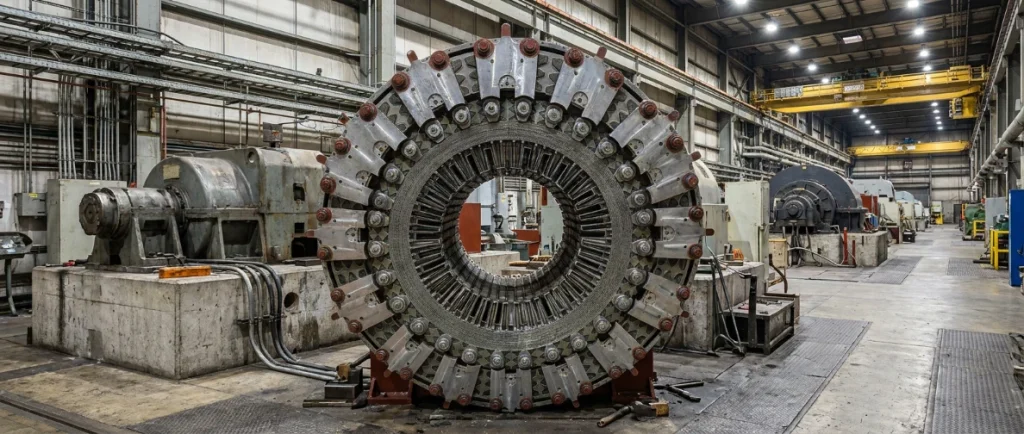
The stator core of a large utility generator is assembled from hundreds of thousands of thin, insulated silicon-steel laminations that must remain tightly clamped to function as a rigid magnetic circuit. In Westinghouse-designed machines, core compression is maintained by two primary bolt systems: long through bolts that run the full axial length of the core, and building bolts that secure the laminations to the frame ribs.
Most units use conventional torquing methods, but many newer or higher-output Westinghouse machines employ hydraulically tensioned through bolts (and, occasionally, hydraulically tensioned building bolts). Periodic through-bolt and building-bolt checks—whether by torque verification or hydraulic-tension verification—are essential offline maintenance procedures that restore and confirm adequate core compression, preventing core vibration, lamination fretting, inter-laminar shorts, and eventual catastrophic core or winding failure. For hydraulically tensioned units, the checks focus on verifying bolt elongation or residual hydraulic preload rather than applied torque.
Background: Why Westinghouse Stator Cores Use Bolted Clamping
Westinghouse developed the building-bolt core construction method in the mid-20th century to create highly rigid stator cores capable of withstanding the intense forces in large turbo-generators. Early designs relied exclusively on manual torquing of through bolts and building bolts. As machine ratings increased in the 1980s and beyond, many Westinghouse units transitioned to hydraulic tensioning systems for the through bolts to achieve more uniform and higher clamping pressures with less risk of thread galling or uneven loading.
Decades of operating experience have shown that loss of clamping pressure—whether from conventional torque relaxation or hydraulic-tension loss—leads to core looseness, increased 120 Hz vibration, fretting wear, and hot spots detectable by ELCID testing. Routine bolt checks (torque-based or hydraulic-tension-based) became standard utility practice in the 1970s and remain a key preventive-maintenance activity for all Westinghouse and legacy Westinghouse-designed generators, with the method adapted to the specific tensioning system installed.
Theory of Operation
Adequate core clamping pressure prevents relative motion between laminations and between the core and frame under electromagnetic forces. Insufficient pressure allows micro-movements that abrade inter-laminar insulation, create low-resistance paths, and generate localized eddy-current heating.
Torque-Based Preload
For conventionally torqued bolts, preload is produced according to the relationship T = K × D × F, where T is the applied torque, K is the torque factor, D is the bolt diameter, and F is the axial preload force. Because K captures friction at the threads and under the nut face, small variations in lubrication, surface finish, or thread condition can shift the resulting preload significantly for the same applied torque.
Hydraulic-Tension-Based Preload
For hydraulically tensioned units, the preload F is applied directly by a hydraulic tensioner that stretches the bolt to a precise elongation, typically measured in thousandths of an inch. The nut is then locked in place while the bolt remains stretched, and the tensioner is released. This method eliminates most of the frictional variability inherent in torque-based methods and is preferred for large-diameter through bolts.
Target Core Clamping Pressure
The target stator core clamping pressure is expressed in pounds per square inch (PSI) across the core end-face area. Industry-practice pressures for Westinghouse machine cores vary by unit design, vintage, and megawatt class. These targets ensure the core remains rigid enough to resist 120 Hz electromagnetic excitation. For hydraulically tensioned bolts, the required hydraulic pressure and resulting bolt elongation are calculated from the target PSI and bolt material properties to achieve the same F as the torque equation above.
Test Procedure Overview
The checks are performed offline, typically with the rotor removed. The procedure is adapted to the tensioning method installed on the unit; the steps below cover both variants in the order a crew would work them during an outage.
1. Preparation
Clean bolt heads, nuts, washers, and tensioner contact surfaces. If the nuts have their threads staked, it is advisable to use a pencil grinder to mill out the deformed thread areas. Use calibrated digital torque wrenches (for torqued units) or hydraulic tensioners and ultrasonic elongation meters (for hydraulically tensioned units), all traceable to national standards.
2. Through-Bolt Check
- Torqued units: Torque each through bolt in a star or criss-cross pattern to the calculated OEM-specified value.
- Hydraulically tensioned units: Attach the hydraulic tensioner, apply the OEM-specified pressure or elongation, lock the nut, and release the tensioner. Verify residual elongation with an ultrasonic bolt gauge if required, then allow 30–60 minutes for relaxation and re-check.
3. Building-Bolt Check
Access the building bolts through the frame ports. For torqued designs, apply the specified torque; for any hydraulically tensioned building bolts, follow the hydraulic procedure used on the through bolts.
4. Verification
Log actual torque values or hydraulic pressure and elongation readings for every bolt. Compare the results against baseline data and the target core clamping pressure so that any drift is visible on the trend record.
5. Safety
Follow proper lock-out/tag-out procedures throughout. Hand safety is imperative when working with hydraulic torque wrenches, and pressurized lines should be routed clear of pinch points before load is applied.
A complete survey on a large generator can usually be completed in one shift by a two-person crew, although hydraulically tensioned units require additional setup time for tensioner calibration.
Place a Generex Technical Field Advisor on-site to oversee work, guide technicians, and protect your interests.
Need Maintenance Direction
and Support?
Interpreting the Results
Bolt-check readings are meaningful only when scored against the OEM target and the unit’s prior baselines. The categories below give crews a consistent way to classify each bolt during the survey and to decide what action, if any, is required before the machine returns to service.
Acceptable
- Torqued bolts: within 80% of the calculated target torque.
- Hydraulically tensioned bolts: elongation or residual tension within OEM-specified limits that produce the same target PSI.
Marginal
Readings 10–20% below the target torque or elongation should be flagged and rechecked at the next shorter outage. Note the bolt locations so the crew can watch for a trend on subsequent surveys.
Unacceptable
Readings more than 20% below target, inability to hold torque or elongation, stripped threads, stretched bolts, or loss of hydraulic preload all fall in this category. Any evidence of core fretting or lamination movement is a serious concern and typically warrants follow-up ELCID testing and a broader stator condition assessment.
Trending
A consistent decline in achievable torque or elongation across successive outages indicates bolt relaxation, frame distortion, or core settling. For hydraulic systems, also monitor for seal degradation or tensioner calibration drift. If the target pressure cannot be achieved, further inspection for thread damage, corrosion, or core-geometry issues is required.
Repair Scenarios
Repair scope depends on how widespread the issue is and whether the core itself shows signs of movement. The three tiers below cover the vast majority of what a bolt survey uncovers on Westinghouse machines.
Minor Looseness
- Torqued units: re-torque using the correct lubrication and sequence.
- Hydraulically tensioned units: re-tension with the hydraulic system to the proper pressure or elongation.
Re-verify after 24 hours in both cases, so that any short-term relaxation is captured before the machine is returned to service.
Moderate Issues
Replace loose, damaged, or corroded bolts, nuts, and washers with OEM-matched hardware. For hydraulic systems, replace any worn tensioner components or seals at the same time, so the next survey is not compromised by known tool defects.
Severe Issues
Widespread low torque or elongation, core fretting, or an inability to reach the target core clamping pressure may require major core repairs, partial or full core restacking, or replacement of through bolts and building bolts. Post-repair ELCID testing is strongly recommended for all units, regardless of tensioning method, and a polarization-index test together with a DC hipot or DC leakage test on the stator winding helps confirm that no collateral insulation damage occurred during the work.
All repairs must be followed by a complete re-torque or re-tension survey to confirm that the target clamping pressure has been restored.
IEEE and ANSI Documentation
Bolt-torque verification, hydraulic-tensioning checks, and core clamping-pressure validation are addressed in IEEE Std 56-2016, IEEE Guide for Insulation Maintenance of Electric Machines, which recommends periodic verification of core clamping (by torque or hydraulic methods) to prevent vibration-induced damage. Additional guidance is found in IEEE Std 1665 (generator rewind practices) and IEEE P1719 (stator core evaluation).
Westinghouse-specific torque tables, hydraulic-tensioning pressures, elongation limits, and clamping-pressure targets are detailed in OEM technical information letters (TILs) and service bulletins such as Westinghouse OMM-099. IEEE 56 remains the primary industry-consensus document and is often dual-designated as ANSI/IEEE. Utilities without the original OEM records on hand often engage a power generation consultant to reconstruct the required targets from vintage documentation and comparable-fleet experience.
Summary and Conclusions
Westinghouse through-bolt and building-bolt checks—whether performed by conventional torquing or hydraulic tensioning—are a straightforward yet highly effective maintenance practice that directly protects the mechanical and electrical integrity of the stator core. By calculating and applying the correct torque or hydraulic preload to achieve the target clamping pressure, utilities prevent core vibration, fretting wear, and the cascade of insulation failures that can lead to expensive forced outages.
When performed systematically—adapting the method to the specific tensioning system—and interpreted against OEM targets per IEEE 56, these checks provide excellent value and significantly extend core life. As aging Westinghouse fleets continue to operate, routine through-bolt and building-bolt verification should remain a cornerstone of any comprehensive generator maintenance program, and pairing it with disciplined trend analysis is one of the most reliable ways to reduce operational costs over the remaining life of the unit.

About the Author
Charles J. Wolfe is the Founder and Principal Engineer of Generex Consulting, with over 30 years of global experience in power generation. He is a recognized expert in generator and excitation systems, trusted by clients worldwide for solving complex engineering challenges.