Partial Discharge Test for Generator Stator Windings
Introduction
Large utility generator stator windings operate at high voltages (13–24 kV) and must withstand intense electrical, thermal, mechanical, and environmental stresses for decades. Over time, insulation can develop voids, delaminations, surface contamination, or poor semiconductive coatings that create localized high electric-field regions. Partial discharge (PD) is a localized electrical discharge that occurs in these regions without completely bridging the insulation between conductors.
The Partial Discharge Test is a sensitive, non-destructive diagnostic method that detects and quantifies these discharges, providing early warning of insulation degradation before it progresses to tracking, carbonization, or catastrophic ground-wall failure.
Background
Partial discharges have been recognized as a primary aging mechanism in high-voltage stator insulation since the 1950s, when epoxy-mica systems began replacing older asphalt-mica materials. Early detection relied on visual corona observation or simple radio-frequency interference (RFI) monitoring. Modern PD testing evolved in the 1970s–1980s with the development of calibrated high-frequency sensors and phase-resolved analysis. The test is now performed both offline (during outages) and online (while the machine is running) and is a cornerstone of predictive maintenance for aging generator fleets.
It is especially valuable for machines that have experienced thermal cycling, contamination, or prolonged operation beyond original design life.
Theory of Operation
Partial discharge occurs when the local electric field stress in a void, delamination, or surface defect exceeds the dielectric strength of the gas (usually air or hydrogen) inside that defect. The electrical theory is governed by the breakdown of gas in a small cavity surrounded by solid insulation. Consider a void of thickness (d) within the ground-wall insulation. The voltage across the void is:
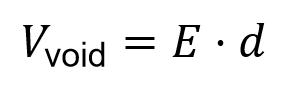
where (E) is the local electric field. When Vvoid reaches the inception voltage (determined by Paschen’s law for the gas pressure and gap distance), the gas ionizes and a rapid discharge occurs. This creates a fast current pulse (nanosecond rise time) with a broad frequency spectrum, typically 50 kHz to 300 MHz or higher. The discharge deposits charge on the void walls, temporarily reducing the field until the next AC cycle. The resulting PD pulses produce:
- High-frequency current pulses detectable by capacitive couplers or high-frequency current transformers (HFCT).
- Electromagnetic radiation and acoustic emissions.
Modern PD systems use phase-resolved partial discharge (PRPD) analysis: each pulse is plotted against the instantaneous AC phase angle. Different defect types produce characteristic patterns (e.g., internal voids show symmetric phase distributions near voltage peaks; surface tracking shows asymmetric patterns; slot discharge shows pulses concentrated in one quadrant).
Test Procedure
PD testing can be performed offline or online. Offline testing is preferred for acceptance testing and detailed diagnostics and is described in detail below.
Offline Testing Procedure
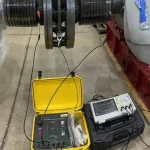
- Preparation: Isolate the stator windings (neutral disconnected, phases separated). Install calibrated PD sensors (80 pF or 1000 pF capacitive couplers) at the line-end of each phase or use permanently installed couplers. For online testing, sensors remain in place during operation.
- Voltage Application: Apply variable AC voltage (usually 0 to 1.0–1.5 × rated line-to-ground voltage) in controlled steps using a PD-free power supply.
- Data Acquisition: Record PD magnitude (in picocoulombs, pC), pulse phase angle, repetition rate, and power loss. Use a calibrated PD detector compliant with IEC 60270 or IEEE 1434.
- Pattern Analysis: Generate PRPD patterns and pulse-height histograms for each phase.
- Safety: Discharge windings after testing and follow IEEE safety guidelines.
Online Testing
Online testing follows similar principles but uses permanently installed sensors, with continuous or periodic monitoring performed while the generator is energized.
Need Expert
Engineering Guidance?
Get independent technical advisory for your power generation project, from design review to project oversight.
Interpreting Results
Results are evaluated against manufacturer baselines, previous tests, and industry guidelines.
PD Magnitude Thresholds
PD magnitude below 100–500 pC at rated voltage is typical for modern epoxy-mica insulation, while readings above 1000–2000 pC are cause for concern.
Phase-Resolved Pattern Types
- Symmetric “rabbit-ear” patterns near voltage peaks indicate internal voids or delaminations.
- Asymmetric patterns shifted to one polarity indicate surface contamination or slot discharge.
- Pulses concentrated near zero-crossing indicate corona at the end-windings.
Voltage Trend and Trending Indicators
PD should remain low until near the inception voltage; a rapid increase above rated voltage indicates severe defects. Rising PD levels, an earlier inception voltage, or changing patterns over time signal progressive degradation. Modern software provides color-coded heat maps and automatic defect classification.
Repair Scenarios
If results are unacceptable, the appropriate corrective action depends on the severity of the PD activity.
Minor PD (Internal Voids)
For low to moderate PD levels associated with internal voids, clean the end-windings, apply surface coatings, or perform localized re-impregnation. Apply heaters and/or dehumidifiers to the stator for 24 hours or more to drive off any moisture, then re-test after curing.
Moderate PD (Surface or Slot Discharge)
For higher PD levels linked to surface or slot discharge, repair or replace the semiconductive slot coatings, stress-grading tape, or end-winding corona shielding.
Severe PD (Multiple Phases Affected)
Very high PD magnitude affecting multiple phases typically requires a full stator rewind or bar/coil replacement. In extreme cases, core slot cleaning or restacking is required.
Post-repair verification must include repeat PD testing (plus Doble power-factor tip-up and hipot testing, if appropriate) to confirm levels have returned to acceptable limits.
IEEE & ANSI Documentation
The primary reference is IEEE Std 1434-2014, IEEE Guide for the Measurement of Partial Discharges in AC Rotating Machinery. Detailed procedures, sensor calibration, and acceptance criteria are also covered in IEEE Std 56-2016, IEEE Guide for Insulation Maintenance of Electric Machines. Supporting information appears in IEEE Std 286 (power-factor tip-up) and EPRI reports on generator PD monitoring. IEEE standards are frequently dual-designated as ANSI/IEEE and represent the globally recognized best practice.
Summary & Conclusions
The Partial Discharge Test is an essential, non-destructive tool for assessing the dielectric health of large utility generator stator windings. By detecting high-frequency current pulses generated when localized electric-field stress causes gas ionization in voids or on surfaces, the test reveals insulation defects long before they cause failure. Phase-resolved analysis and trending provide clear diagnostic insight into defect type and severity. When performed per IEEE 1434 and interpreted with manufacturer baselines, PD testing enables proactive repairs—cleaning, recoating, or rewinding—that prevent unplanned outages and extend stator life. As generator fleets age and operate under higher cyclic demands, routine partial-discharge testing (both offline and online) has become a cornerstone of modern predictive maintenance programs, delivering high reliability at relatively low cost.

About the Author
Charles J. Wolfe is the Founder and Principal Engineer of Generex Consulting, with over 30 years of global experience in power generation. He is a recognized expert in generator and excitation systems, trusted by clients worldwide for solving complex engineering challenges.