Generator Bearing Maintenance, Inspection & Failure Analysis
Introduction
Generator bearings in large, utility-scale turbine-driven synchronous machines are among the most critical and highly stressed mechanical components in the plant. These journal or tilting-pad bearings support the massive rotor weight and handle dynamic loads from high-speed rotation, thermal expansion, and electromagnetic forces. Effective bearing maintenance, inspection, and root-cause failure analysis (RCFA) directly impact machine reliability, vibration control, and outage planning. Failures can lead to forced outages, rotor damage, or extended downtime costing millions. For consulting firms specializing in generator testing, inspection, and repair, expertise in bearing diagnostics provides essential services that identify early degradation, determine root causes, and recommend targeted repairs to extend asset life and minimize risk.
Background: How Generator Bearings Are Loaded and Why They Fail
Large turbine-driven generators typically operate at 3,600 or 1,800 rpm with rotors weighing tens of tons. The bearings—often hydrodynamic journal bearings with Babbitt-lined shells or tilting-pad designs—operate under extreme conditions: high loads, elevated temperatures, and continuous exposure to turbine lube oil. Over decades of service, bearings experience wear from lubrication issues, misalignment, contamination, vibration, and electrical discharge.
Industry data shows that lubrication problems and contamination account for a large percentage of bearing failures, while misalignment and overload frequently contribute. Early detection through vibration monitoring, oil analysis, and visual inspection prevents progression to wiping, fatigue cracking, or catastrophic failure. Proactive programs are especially important for aging fleets facing increased cyclic duty and grid-induced transients.
Theory of Operation
Generator bearings function as hydrodynamic fluid-film bearings. A thin oil film separates the rotating journal (shaft) from the stationary bearing surface, supporting the load through hydrodynamic pressure generated by shaft rotation. In tilting-pad bearings, individual pads tilt to optimize film thickness and stability.
Key Operating Parameters
The parameters that define bearing performance are oil viscosity, supply pressure, temperature, clearance, and flow rate. Proper operation maintains a minimum film thickness sufficient to avoid metal-to-metal contact. Any deviation—low supply pressure, elevated inlet temperature, or degraded viscosity—directly reduces that safety margin.
Forces Acting on the Bearing
Forces acting on bearings include static rotor weight, dynamic unbalance, misalignment-induced loads, and electromagnetic effects. Excessive vibration or thermal bow can overload pads, while shaft voltage may drive electrical discharge through the oil film, causing pitting or fluting.
Lube-Oil Condition
Oil must remain clean, at the correct temperature (typically 40–60 °C inlet), and free of water or particulates to preserve film integrity and prevent Babbitt fatigue or wiping. Oil-cooler performance is inseparable from bearing performance—degraded cooling shows up first as rising bearing metal temperature, which is why cooling-system health belongs in every bearing review.
Maintenance Procedures
Bearing maintenance integrates continuous online monitoring with detailed offline inspections during planned outages. The steps below outline a practical program for large turbine-driven generators.
1. Online Monitoring
Continuously track bearing metal temperatures (via embedded RTDs or thermocouples), vibration (proximity probes), oil inlet and outlet temperatures, differential pressure, and flow. Trend the data so rising temperatures or vibration produce an early warning long before an alarm setpoint is reached.
2. Lubricant Analysis
Perform regular sampling for particle count, water content (target below 100–200 ppm), viscosity, acidity, and wear metals. Spectrographic and ferrographic analysis detect early degradation and can pinpoint which component is shedding material before visual inspection is possible.
3. Visual and Dimensional Inspection
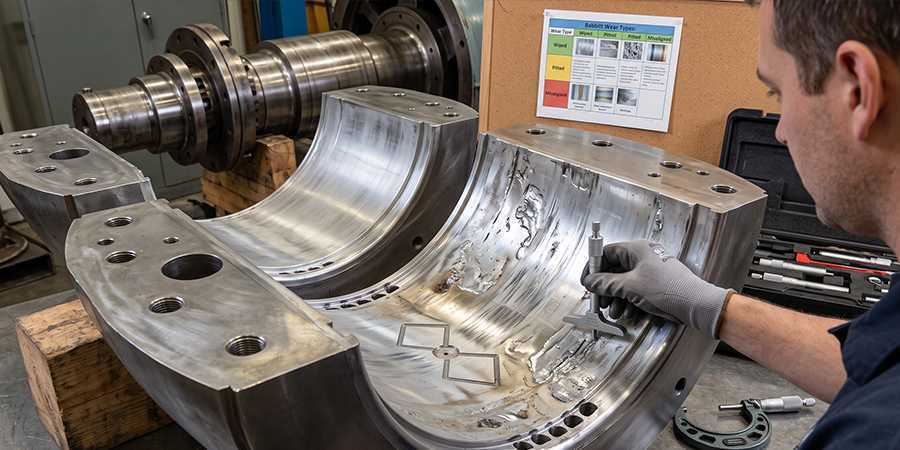
During outages with the rotor lifted, examine Babbitt surfaces for wiping, cracking, fretting, or discoloration; measure diametral clearance, ellipticity, and pad wear; and inspect oil grooves, seals, and bearing insulation (where applicable).
4. Nondestructive Testing
Use dye penetrant or magnetic-particle testing for surface cracks, ultrasonic testing for bonding defects in the Babbitt, and hardness testing for material changes. Findings from NDT often determine whether a pad can be reused or must be re-babbitted.
5. Alignment and Runout Checks
Verify turbine-generator train alignment and shaft runout at each major outage. Even small offsets or angular misalignments produce edge loading that will re-appear as elevated temperatures and vibration within months of return-to-service.
6. Documentation
Record all data with photographs, measurements, and comparison to baseline for trending. A full bearing procedure is recommended every four to eight years, or after any high-vibration event, with oil analysis performed more frequently—typically quarterly or semi-annually.
Our engineers identify the true root cause of equipment failures, and help prevent future events
Why Did Your Unit
Suddenly Trip?
Common Issues and Remedies
Most bearing problems on large generators fall into a handful of recurring patterns. Recognizing the symptom set and the underlying root cause is what separates a durable repair from one that returns within a year.
Lubrication Failure
Insufficient flow, wrong viscosity, or degraded oil lets the film break down, driving overheating and Babbitt wiping. Remedy: optimize oil supply, tighten filtration, and follow a precise sampling and analysis protocol so viscosity drift is caught early.
Contamination
Particulates, water, or varnish cause abrasive wear or corrosion. Remedy: upgrade filtration and shaft seals, perform system flushes on a defined cadence, and control oil chemistry through additive monitoring.
Misalignment
Offset or angular misalignment from foundation settling, thermal growth, or improper installation causes edge loading and fatigue. Remedy: laser-align the entire train, and perform periodic soft-foot checks so a corrected alignment stays corrected.
Electrical Discharge
Shaft voltage causes pitting, fluting, or spark erosion through the oil film. Remedy: install or maintain shaft grounding brushes, and confirm bearing insulation integrity where insulated bearings are fitted.
Overload or Vibration
Rotor unbalance, thermal bow, or shorted turns produce sustained overload that fatigues the Babbitt. Remedy: address the underlying mechanical or electrical fault through balancing or, when a shorted-turn fault is confirmed by AC impedance testing, targeted rotor winding repair.
Oil Whirl and Instability
Sub-synchronous vibration originating in fluid-film dynamics indicates a marginal bearing design or worn clearances. Remedy: bearing redesign (for example, tilting-pad optimization) or increased damping to shift the instability threshold well above the operating speed.
Root-cause failure analysis should integrate vibration spectra, oil-debris analysis, temperature trends, and metallurgical examination of damaged Babbitt to distinguish symptoms from underlying causes such as poor installation, inadequate maintenance, or operational transients.
Repair Scenarios
Repair scope is guided by inspection findings and RCFA results. The three tiers below cover almost every scenario a large-generator crew will encounter.
Minor Repairs
Light wiping, minor scoring, or contamination is addressed with in-situ polishing, oil-system flushing, and filter replacement during a short outage (typically one to three days).
Moderate Repairs
Localized Babbitt damage, excessive clearance, or pad wear calls for re-babbitting of individual pads or shells, clearance adjustments, and lube-oil-system upgrades. Expect a one- to three-week outage window.
Major Repairs
Widespread fatigue cracking, severe misalignment damage, or electrical erosion requires full bearing replacement, rotor journal repair or sleeving, high-speed balancing, and a complete lube-system overhaul—four to twelve weeks or longer. In extreme cases, rotor straightening or replacement is necessary. Post-repair activities include alignment verification, oil flushing, and loaded vibration and temperature acceptance testing. All repairs must use OEM-approved Babbitt alloys and maintain original design clearances, and any winding work uncovered during the outage should be validated with a polarization-index test before the machine is closed up.
IEEE and Industry Documentation
Bearing maintenance and monitoring for large synchronous machines are addressed in IEEE Std 67 (Guide for Operation and Maintenance of Turbine Generators), which recommends periodic inspection, vibration analysis, and lubrication programs. Additional references include API 670 (machinery-protection systems) for vibration and temperature monitoring, ISO 10816 for vibration severity, and OEM bearing manuals for design-specific clearances and Babbitt specifications. When historical records are incomplete, a power generation consultant can reconstruct baselines from comparable-fleet data and vendor documentation so trending remains defensible.
Summary and Conclusions
Generator bearing maintenance, inspection, and root-cause failure analysis are vital to the mechanical reliability of large utility turbine-driven generators. These hydrodynamic bearings operate under demanding conditions where lubrication integrity, alignment, and contamination control determine service life. Systematic online monitoring of temperatures and vibration, combined with rigorous offline inspections and lubricant analysis, enables early detection of issues such as wiping, fatigue, or electrical erosion.
When failures occur, a structured RCFA that integrates multiple data sources identifies the true root cause rather than the superficial symptom, guiding effective repairs from minor polishing to full bearing replacement. Adherence to IEEE Std 67 and related standards, supported by meticulous documentation and trending, ensures compliance, reduces outage risk, and optimizes maintenance intervals. For utilities managing aging fleets under cyclic operation, expert consulting services in bearing testing, inspection, and repair deliver significant value by preventing catastrophic failures, minimizing downtime, and helping reduce operational costs across the remaining life of the asset. Implementing a robust bearing program remains one of the most proven strategies for achieving high availability and long-term reliability in today’s power generation environment.

About the Author
Charles J. Wolfe is the Founder and Principal Engineer of Generex Consulting, with over 30 years of global experience in power generation. He is a recognized expert in generator and excitation systems, trusted by clients worldwide for solving complex engineering challenges.