Tube-to-Tube & Tube-to-Copper Resistance Test Guide
Tube-to-Tube and Tube-to-Copper Resistance Tests on Westinghouse and MHI Hydrogen Inner-Cooled Stator Windings
Westinghouse hydrogen inner-cooled generators — common in many large utility units — use stainless steel square cooling tubes embedded between the copper conductor strand stacks of each stator bar. These tubes carry hydrogen gas for direct cooling of the stator winding. The tube-to-tube and tube-to-copper resistance tests are critical diagnostic procedures developed specifically for these designs.
Why These Tests Are Performed
In hydrogen inner-cooled stator bars, the stainless steel square cooling tubes must remain electrically isolated from each other and from the surrounding copper strands. Over time, several issues can compromise that isolation:
- Degradation or cracking of the thin insulation between the stainless steel tubes and the copper
- Mechanical vibration causing abrasion of the tube insulation — an issue that ongoing vibration monitoring and analysis can help catch early
- Thermal cycling leading to insulation breakdown
- Contamination or carbon tracking inside the bar
If any cooling tube becomes electrically shorted to another tube or to the main copper conductor, large circulating currents are induced inside the bar. These currents cause severe localized heating, accelerated insulation degradation, and can lead to bar failure or a major stator ground fault. Because standard tests such as Megger, polarization index (PI), Hipot, and transposition checks often cannot detect these internal shorts, the tube-to-tube and tube-to-copper tests are the primary method for finding them early.
Tube-to-copper testing also verifies that the nominal 5 kΩ resistor connecting the copper to the top and/or bottom cooling tube is still good. This resistor keeps the tube stack and copper at the same voltage without passing significant current, which is particularly important during offline high-voltage testing.
These tests are especially important for older Westinghouse hydrogen inner-cooled machines, as the stainless steel tubes are more prone to insulation wear than in modern designs.
Theory of the Tests
Each stator bar contains multiple stainless steel square cooling tubes running parallel inside the copper conductor stack. These tubes are wrapped or coated with thin electrical insulation to prevent them from making contact with each other or with the copper.
Tube-to-Tube Test
Measures the insulation resistance between any two individual stainless steel cooling tubes within the same bar. The goal is to confirm high resistance between tubes — high enough that no significant current can flow between them.
Tube-to-Copper Test
Measures the insulation resistance between an individual stainless steel cooling tube and the main copper conductor of the bar.
In a healthy bar, the insulation should show very high resistance. A low resistance reading indicates that the insulation has failed and a short-circuit path now exists.
Controlling Standards and Documentation
- IEEE Std 62.2 — Guide for Diagnostic Field Testing of Electric Power Apparatus (Electrical Machinery). It covers strand and tube insulation testing for large generators.
- Westinghouse / Siemens Energy service bulletins and maintenance manuals — the primary reference documents used by service teams for hydrogen inner-cooled generators.
- ANSI/NETA MTS — Maintenance Testing Specifications for rotating machinery.
These tests are considered OEM-specific best practice for Westinghouse hydrogen inner-cooled stator windings.
Test Method and Procedure
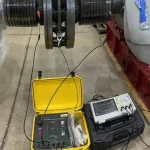
Connect the test instrument to the designated tube ends and take the required resistance/insulation measurement. Record and evaluate the readings against manufacturer specifications or previous test results
Prerequisites
- Generator shut down and locked out
- Rotor removed or end bells off for access
- Hydrogen cooling system purged and isolated
- Stator winding electrically isolated
Equipment
- High-range digital multimeter or micro-ohmmeter capable of measuring up to several hundred megohms
- Clean test leads with good contact probes suitable for the stainless steel tube ends
Procedure Overview
1. Gain access to the cooling tube ends at the water/hydrogen header connections or bar clips.
2. Tube-to-tube test: measure resistance between every pair of stainless steel cooling tubes in the same bar.
3. Tube-to-copper test: measure resistance between each stainless steel cooling tube and the main copper conductor of the bar (or a known good copper point on the bar). Clip one ohmmeter lead to the stator phase — typically at a bushing — and the other probe to the individual cooling tube entrance.
4. Record readings for every bar in all three phases.
The tests are low-voltage and non-destructive.
Need Maintenance Direction
and Support?
Place a Generex Technical Field Advisor on-site to oversee work, guide technicians, and protect your interests.
Interpreting Results
Results are evaluated on a per-bar basis across all three phases and should be carefully trended against data from previous outages. In a healthy Westinghouse hydrogen inner-cooled stator bar, the insulation between individual cooling tubes and between the tubes and the main copper conductor should exhibit very high resistance. Low or progressively declining readings indicate insulation breakdown, contamination, or shorted paths that can produce circulating currents and localized overheating.
General Interpretation Guidelines
- High resistance (multi-megohm range) — expected across all tube-to-tube and tube-to-copper measurements in good condition.
- Moderate or inconsistent readings — suggest developing degradation and warrant closer monitoring or inspection.
- Low resistance (especially below ~100 kΩ, or sudden drops) — signals failed insulation or short circuits and requires prompt attention.
Key Observations
- A single low reading usually points to a localized fault.
- Multiple low readings in the same bar typically indicate more widespread insulation damage or carbon tracking.
- An open circuit (very high or infinite resistance) on a tube-to-copper measurement may indicate a failed equalizing resistor (commonly on the order of several kΩ in this design) that should be checked and replaced if necessary.
Trending is particularly important for this test. Gradual deterioration over time is a strong early warning of mechanical wear, thermal cycling effects, or contamination inside the bar.
Actions for Marginal or Poor Results
- Clean the tube ends thoroughly and retest immediately — surface contamination, oxidation, or moisture can produce misleading low readings.
Perform a detailed visual and borescope inspection wherever accessible for signs of tracking, abrasion, or discoloration. Combining this with related mechanical checks such as Westinghouse stator bolt inspections during the same outage window is often efficient.
Repair Options
Listed from least to most invasive:
- Localized cleaning, drying, and application of suitable semiconducting varnish or coatings at the tube ends.
- Replacement of failed equalizing resistors.
- Replacement of the affected stator bar — the most common and reliable fix for confirmed internal shorts.
- In severe or widespread cases, plan a partial or full stator rewind.
All repairs must be followed by repeat tube-to-tube and tube-to-copper testing — along with other standard electrical tests — to confirm acceptable insulation integrity before the generator is returned to service.
Summary and Conclusions
Bad results should never be ignored — operating with shorted cooling tubes can lead to rapid overheating and stator winding failure.
Bottom line: the tube-to-tube and tube-to-copper resistance tests are essential for Westinghouse hydrogen inner-cooled generators using stainless steel square cooling tubes. They detect internal shorts that other standard tests miss, and they are a key part of a thorough stator diagnostic program.

About the Author
Charles J. Wolfe is the Founder and Principal Engineer of Generex Consulting, with over 30 years of global experience in power generation. He is a recognized expert in generator and excitation systems, trusted by clients worldwide for solving complex engineering challenges.