AC High Potential Test on Large Utility Generator Stators
Introduction
The AC high potential (HiPot) test is a definitive overvoltage withstand test performed on the stator windings of large utility generators to verify the dielectric strength and integrity of the ground-wall insulation. By applying an AC voltage significantly higher than normal operating voltage, the test stresses the insulation to levels that simulate, and exceed, service conditions, revealing hidden defects such as voids, delaminations, poor impregnation, or mechanical damage that could lead to in-service failure.
Because it is performed at power frequency (50/60 Hz), the test replicates the actual electrical stress distribution the winding experiences in operation.
Background
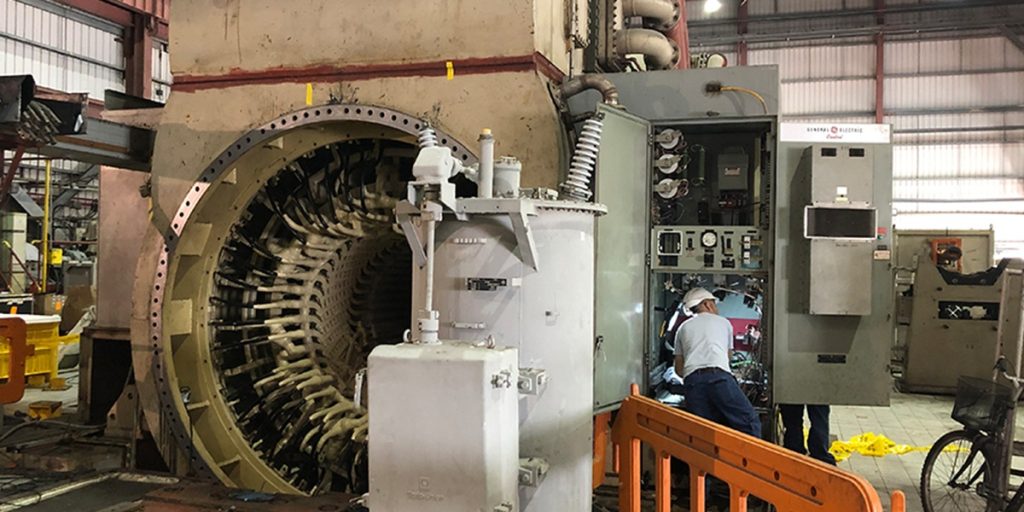
AC HiPot testing has been a standard acceptance and post-repair verification method since the early days of high-voltage generators. Early asphalt-mica systems were prone to voids and tracking; modern epoxy-mica systems are more robust but still require proof testing after a rewind or major repair. The test is especially critical following stator bar or coil replacement, re-wedging, or a full rewind, where workmanship defects could otherwise remain undetected until an in-service fault occurs. It is performed offline during factory acceptance, commissioning, and major outages, and it serves as the final “go/no-go” verification before the machine is returned to service. In practice, the AC HiPot is rarely done during routine maintenance inspections; instead, it is most often seen on full stator rewind jobs performed in the factory or the field.
Theory of Operation
The stator winding insulation can be modeled as a distributed capacitance (C) in parallel with a small leakage resistance (R). When an AC voltage (V) is applied, the total current consists of a large capacitive charging component and a small resistive leakage component. The test voltage stresses the insulation at levels well above normal operation, forcing any weak points to break down or produce excessive leakage.
The electrical theory is based on the dielectric withstand capability of the insulation system. The peak test voltage is chosen to produce a stress margin (typically 1.5–2× rated line-to-ground voltage) that ensures the insulation can withstand transient overvoltages in service. The applied AC voltage produces both capacitive stress (a uniform field distribution similar to operation) and dielectric heating, which reveals defects that DC testing might miss.
Tuning the Inductor
Large stator windings have very high capacitance (often tens to hundreds of microfarads per phase). Supplying the required charging current directly from a conventional transformer would demand megavolt-ampere (MVA) power sources. To reduce the power requirement, a variable series inductor (L) is inserted between the test transformer and the stator winding. The inductor is tuned so that its inductive reactance XL = ωL exactly cancels the capacitive reactance XC = 1/(ωC) of the winding at line frequency:
XL = XC ⇒ ωL = 1/(ωC)
At resonance, the circuit impedance drops to the small resistive component of the winding plus the losses in the inductor and transformer. The supply now only needs to provide the real power losses (typically a few kVA instead of MVA), making the test practical in a field environment. The variable inductor is adjusted until the input current is minimized (the resonance point), and the test voltage is then raised while current is monitored and the winding is watched for breakdown.
AC Versus DC HiPot
AC HiPot is the industry standard for post-rewind verification because it closely replicates the electric-field distribution and partial-discharge (PD) behavior experienced in service. AC voltage produces peak stresses at the same points as operating voltage, drives PD activity realistically, and does not leave trapped space charges that can mask defects or cause subsequent damage. DC HiPot, while useful for routine maintenance or when AC power is unavailable, applies a uniform field that does not stress the insulation in the same way as AC and can polarize the dielectric, potentially hiding voids or creating new defects upon re-energization. Standards therefore require AC HiPot for final acceptance after major winding work.
Test Procedure
The test is performed offline with the rotor removed, or in place if air-gap clearance allows. The key steps are as follows:
- Preparation: Isolate the stator windings (neutral disconnected, phases separated). Clean the end-windings and install temporary corona shielding if needed. Connect the resonant test set (transformer plus variable inductor) to each phase individually.
- Resonance tuning: Energize at low voltage and adjust the inductor until the input current is minimized, confirming resonance.
- Voltage application: Raise the voltage in controlled steps (typically 25% increments) to the specified test level (commonly 2E + 1 kV rms, or 1.5–2× rated line-to-ground voltage, held for one minute). Monitor leakage current, power factor, and PD activity where applicable.
- Observation: Watch for audible discharge, smoke, or a sudden current increase that indicates breakdown.
- Safety: Discharge the windings through a resistor after each phase and verify zero voltage before handling the leads.
The complete test for a large generator typically takes four to eight hours, depending on the size of the machine.
Interpreting Results
Results are classified into three categories based on how the winding behaves during the one-minute hold at test voltage:
- Pass: No breakdown, flashover, or excessive leakage current during the one-minute hold at test voltage. Leakage current remains stable and within the expected limits for the winding capacitance.
- Marginal: A slight increase in leakage or PD activity that does not cause failure but requires investigation.
- Fail: Any audible or visible discharge, a sudden current spike, or complete breakdown during the test-voltage hold. The phase that failed must be identified and repaired.
Results are recorded with the test voltage, hold time, leakage current, and any anomalies. Trending against previous tests is important; increasing leakage over time indicates progressive insulation aging.
Repair Scenarios
When the test fails, the appropriate corrective action depends on the extent of the damage:
- Minor defects (localized tracking or surface discharge): Clean and reapply corona shielding, stress-grading tape, or insulating varnish. Re-test after curing.
- Moderate defects (bar or coil insulation damage): Replace individual bars or coils in the affected phase, then re-perform a full AC HiPot on the repaired phase.
- Severe or widespread defects (multiple phases fail or gross insulation failure): A full stator rewind or major bar replacement is required. A post-repair AC HiPot, plus PD and power-factor tests, is mandatory before return to service.
All repairs must be followed by a successful repeat AC HiPot test to confirm that the insulation system meets specifications.
Get independent technical advisory for your power generation project, from design review to project oversight.
Need Expert
Engineering Guidance?
IEEE & ANSI Documentation
The AC high potential test is formally described in IEEE Std 115-2019, IEEE Guide for Test Procedures for Synchronous Machines, and IEEE Std 56-2016, IEEE Guide for Insulation Maintenance of Electric Machines. Detailed procedures, voltage multipliers, and acceptance criteria appear in IEEE Std 4, IEEE Standard for High-Voltage Testing Techniques. These standards specify the use of AC over DC for post-rewind verification and emphasize resonant-circuit techniques for large machines. IEEE documents are frequently dual-designated as ANSI/IEEE and represent the globally recognized best practice.
Summary & Conclusions
The AC high potential test is the definitive proof test for stator winding insulation in large utility generators. By applying a resonant-tuned AC overvoltage that closely simulates service electrical stress, the test reliably exposes weaknesses that DC testing might miss. The theory of inductor tuning allows practical field testing of high-capacitance windings with modest power sources, while the preference for AC over DC ensures a realistic stress distribution and PD behavior, making AC the required standard for post-rewind verification. When performed and interpreted according to IEEE 115 and IEEE 56, the test provides high confidence that the stator can operate reliably for years to come. As generator fleets age and face increasing cyclic duty, routine AC HiPot testing after any major winding work remains an indispensable safeguard against catastrophic insulation failure.

About the Author
Charles J. Wolfe is the Founder and Principal Engineer of Generex Consulting, with over 30 years of global experience in power generation. He is a recognized expert in generator and excitation systems, trusted by clients worldwide for solving complex engineering challenges.