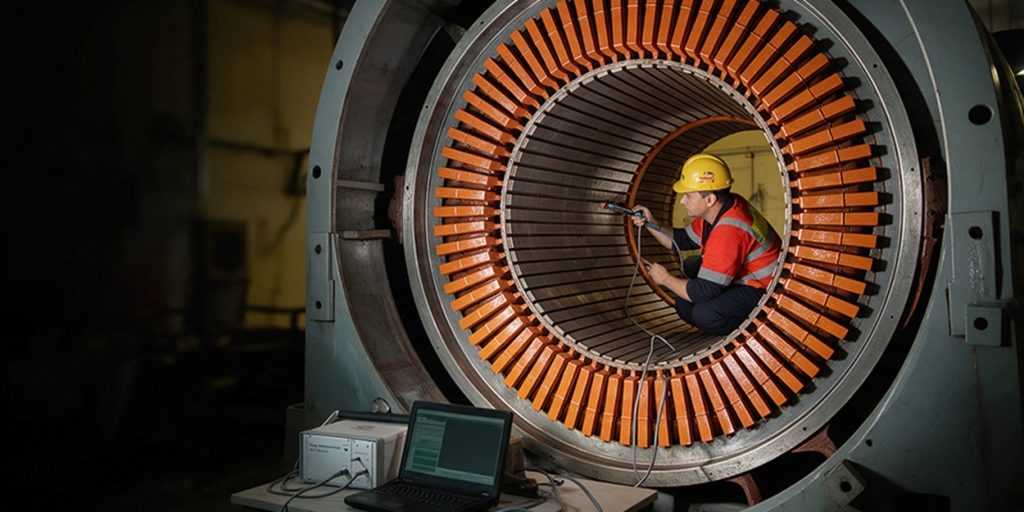
Stator Wedge Tightness Evaluation | Wedge Tap Test
Introduction
Stator wedges in large utility generators mechanically secure the high-voltage winding bars firmly within the core slots against powerful electromagnetic forces acting at twice line frequency (100/120 Hz). Loose wedges allow bar vibration, insulation abrasion, slot partial discharge, fretting, and eventual ground-wall failure.
The wedge tap test — the traditional hammer-tap acoustic method combined with modern quantitative Leeb rebound testing — and the wedge PSDS / top ripple spring deflection test are essential offline diagnostic procedures used to evaluate wedge tightness and the condition of the radial pressure system.
Terminology clarification. “Wedge PSDS” is a Westinghouse term for the Pre-Stressed Driving Strip, a ripple-spring-like insulating filler placed between the bottom of the wedge and the upper coil-side filler strips in modern designs to maintain constant radial pressure. “Top Ripple Spring” (TRS) is the term GE coined for the same wavy filler strip. The TRS/PSDS deflection test quantifies the compression of the top ripple springs or PSDS that provide the primary radial clamping force. These tests are performed together and are collectively known as wedge tightness evaluation.
Background
Wedge looseness has been a persistent reliability concern since the earliest large generators. Traditional “hammer-tap” acoustic testing has been used for decades, relying on subjective interpretation of sound. In the 1980s–1990s, quantitative methods emerged: Leeb rebound hardness testing for objective acoustic data, and precision depth gauges for ripple-spring deflection. Today both the classic hammer-tap method and modern Leeb testing are used in parallel during factory acceptance, commissioning, routine outages, post-rewind verification, and root-cause investigations. They complement ELCID core testing, partial-discharge monitoring, and visual inspections, enabling early detection of looseness before it progresses to slot discharge or bar migration.
Theory of Operation
Stator wedges are held by radial pressure from top ripple springs or PSDS that press the bars against the slot bottom. Electromagnetic forces try to lift the bars; insufficient pressure allows micro-movement and vibration, leading to insulation wear and partial discharge.
Traditional Hammer-Tap Method
A small (1–2 ounce) ball-pein hammer delivers a controlled impact to the wedge surface. A tight wedge produces a sharp, crisp, high-pitched “click” because the energy is reflected efficiently with minimal damping. A loose wedge absorbs energy through vibration and relative motion, producing a dull, hollow, low-pitched “clack.”
Experienced technicians press a finger firmly on the wedge during the tap to feel for significant mechanical response (vibration or actual movement). They also inspect the wedge dovetail area for signs of movement: greasing (greasy black deposits from bar-to-wedge contact), dusting (fine insulation or core particles), or visible gaps indicating looseness. These combined sensory inputs — acoustic return, tactile vibration feedback, and visual evidence — provide an immediate qualitative assessment of wedge condition.
Modern Quantitative Wedge Tap (Leeb Rebound Method)
A portable hardness tester (for example, an Equotip) uses an impactor with a tungsten-carbide or diamond-tipped ball, propelled by spring force at a known impact velocity. Both the impact and rebound velocities are captured:
- vᵢ = impact velocity (known)
- vᵣ = rebound velocity (measured electronically)
The coefficient of restitution is:
e = vᵣ / vᵢ
The Leeb hardness value (HL) is scaled directly from this coefficient:
HL = 1000 × e
This yields a 0–1000 dimensionless number. Higher Leeb values indicate tighter wedges (less energy loss); lower values indicate looseness.
Top Ripple Spring / PSDS Deflection Test
Ripple springs or PSDS are pre-compressed flat springs. Deflection is measured through the wedge access holes with a precision depth gauge and compared with the known uncompressed height to calculate percent compression. Industry targets require ≥70% compression to maintain adequate radial pressure (>0.005 MPa).
The stator core has rings or bands of test wedges with 7–9 small holes arranged in a line. These let a depth-gauge pin penetrate the thickness of the wedge so the tip contacts the top of the TRS/PSDS along the length of one wavelength, capturing the peak and trough of one wave. A tight wedge has a nearly flat TRS/PSDS spring, so the difference between peak and trough is minimal; a looser wedge has less compression and therefore a greater spread between crest and trough measurements.
Place a Generex Technical Field Advisor on-site to oversee work, guide technicians, and protect your interests.
Need Maintenance Direction
and Support?
Test Procedure
Testing is performed offline with the rotor removed (or in place using robotic systems). The hammer-tap method, Leeb testing, visual inspection, and ripple-spring deflection are often performed together for a comprehensive evaluation. The key steps are:
- Preparation. Clean the wedge surfaces and access holes, and record the ambient temperature. Prepare a calibrated hammer, a Leeb hardness tester, and an electronic depth gauge. If the stator has yellowish-green deposits, take sample swabs to be analyzed for suspected lead-carbonate contamination.
- Wedge tap test (combined traditional and Leeb). Perform the following at each wedge:
- Strike each wedge with the hammer at the center and near each end, listening for the acoustic return (sharp ring vs. dull thud).
- Simultaneously press a finger firmly on the wedge to detect mechanical vibration or “buzz.”
- Visually inspect the wedge dovetail for greasing, dusting, or looseness.
- Immediately follow with the Leeb hardness tester: perform three impacts at the center and one on each side (five total per wedge), then average the Leeb readings.
- Top ripple spring / PSDS deflection test. Insert the depth gauge through the access hole, record the deflection, and calculate percent compression.
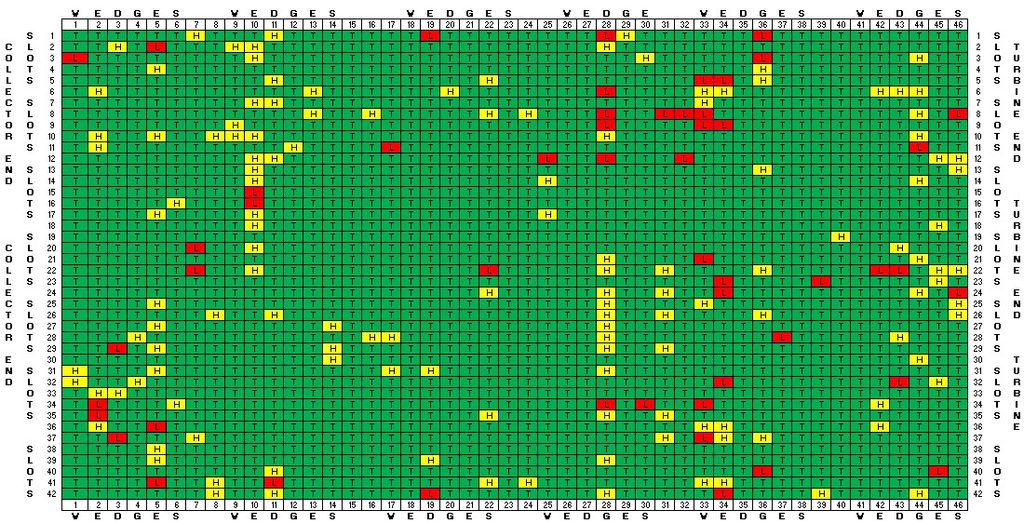
- Documentation. Map the results slot by slot, noting acoustic, tactile, and visual observations alongside Leeb values and deflection percentages. Photograph any anomalies.
- Safety. Follow lock-out / tag-out procedures throughout.
A full stator survey on a large generator can typically be completed in 1–2 shifts by a two-person team.
Interpreting the Results
Findings are strongest when the sensory cues and the quantitative readings agree. The acceptance guidance for each method is below.
Wedge Tap (Acoustic, Tactile & Visual)
- Sharp ring + no finger vibration + clean dovetail = tight.
- Dull thud + felt vibration/buzz + greasing/dusting = loose.
Leeb Hardness (Typical Criteria)
- Tight: >650 Leeb
- Marginal: 550–649 Leeb
- Loose: <549 Leeb
Top Ripple Spring / PSDS Deflection
- ≥70% compression = acceptable.
- <70% compression = loose.
Additional Rules
- No more than 25% loose wedges in any slot.
- No two adjacent loose wedges.
- Neither end wedge should be loose.
Correlate the acoustic, tactile, and visual cues with the Leeb values and deflection data. Trending is critical: a rising number of dull taps, felt vibration, greasing, or declining Leeb/deflection values indicates progressive loosening, so these results belong in an ongoing predictive maintenance and condition monitoring record.
Repair Scenarios
The recommended response scales with the extent of looseness and the condition of the springs:
- Minor looseness (<10–15% of wedges affected, Leeb >550, springs >60% compressed, minimal greasing): clean the affected areas and recommend that the customer prepare for a possible stator re-wedge at the next major outage.
- Moderate issues (15–25% loose wedges, springs 50–70% compressed, moderate greasing/dusting): replace ripple springs/PSDS, add side packing, or perform localized re-wedging, then re-test the entire slot.
- Severe issues (>25% loose wedges, multiple adjacent loose wedges, springs <50% compressed, heavy greasing/vibration): perform full-slot or complete stator re-wedging. Post-repair ELCID and DC leakage / hipot testing are recommended.
All repairs require 100% re-testing with the hammer-tap method (acoustic/tactile/visual), Leeb, and deflection methods to confirm the acceptance criteria before return to service.
IEEE & ANSI Documentation
Wedge tightness testing is formally addressed in IEEE Std 1665-2024 (and the 2009 edition), IEEE Guide for the Rewind of Synchronous Generators, 50 Hz and 60 Hz, Rated 1 MVA and Above, which defines PSDS and provides acceptance criteria for wedge and ripple-spring systems. Supporting guidance appears in IEEE Std 56-2016, IEEE Guide for Insulation Maintenance of Electric Machines, and in EPRI Report 3002018669, Generator Stator Wedge Test Guide. The Leeb rebound method aligns with ISO 16859 / ASTM A956. OEM technical information letters provide machine-specific Leeb thresholds, deflection limits, and guidance on combining acoustic, tactile, and visual observations. IEEE 1665 remains the globally recognized reference.
Summary & Conclusions
The wedge tap test — combining traditional hammer-tap acoustic return, finger-press tactile feedback, visual inspection for greasing/dusting/looseness in the wedge dovetail, and modern Leeb rebound hardness measurement — together with the wedge PSDS / top ripple spring deflection test, provides a fast, objective, and repeatable assessment of stator wedge tightness and radial clamping pressure. By using both sensory (acoustic/tactile/visual) and quantitative (Leeb scaled from the coefficient of restitution, plus deflection) data, technicians detect looseness long before it causes slot discharge or bar damage.
Performed and interpreted according to IEEE 1665 and OEM criteria, these tests enable proactive repairs — shimming, spring replacement, or re-wedging — that prevent forced outages and extend stator life. As generator fleets age and operate under increasing cyclic duty, routine wedge tightness evaluation using the full hammer-tap method plus Leeb and deflection testing has become an indispensable element of modern predictive maintenance programs, delivering high reliability at minimal cost.

About the Author
Charles J. Wolfe is the Founder and Principal Engineer of Generex Consulting, with over 30 years of global experience in power generation. He is a recognized expert in generator and excitation systems, trusted by clients worldwide for solving complex engineering challenges.